
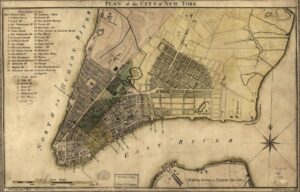
Plan of the city of New York, 1789, John McComb and Cornelius Tiebout, Library of Congress
On November 25, 1783, James Duane rode into New York City in a triumphal procession. As the British evacuated the city, Duane and other revolutionaries found a city devastated by fires and crowded with people.[1] Duane described two of his houses, at the Fly Market and on King Street, “as if they had been inhabited by savages or wild beasts.”[2]
Duane was an influential attorney who attended the Continental Congress, helped draft New York’s constitution, and was later a judge. He was a reluctant revolutionary, who believed that Parliament had violated the British constitution and the rights of colonists.[3] In April 1775, Duane authored a statement for “the Freemen, Freeholders, and Inhabitants of the City and County of New-York” who opposed acts to “raise a revenue in America” and “in the most solemn manner, resolve never to become slaves.”[4]
On February 5, 1784, Governor George Clinton appointed James Duane the first post-revolutionary mayor and the forty-fifth mayor since the founding of New York. [5] Duane was an enslaver and Mary Livingston, his wife, was descended from some of the wealthiest slave traders in the state. Her relative Edward Livingston was an enslaver who served as the forty-seventh mayor and was the eleventh Secretary of State.
While successful merchants continued to be mayor, many of the mayors at this time worked as attorneys and politicians. The mayors included well-known revolutionary figures, including Duane, Forty-Sixth Mayor Richard Varick, and Forty-Ninth Mayor Marinus Willett, all enslavers. Others included Fifty-Eighth Mayor Philip Hone, an auctioneer and one of the richest men in the city, and DeWitt Clinton, a member of a political dynasty and the forty-eighth, fiftieth, and fifty-second mayor.
The structure of New York City’s government remained similar to colonial times, but state officials were elected. The mayor was appointed by the Council of Appointment, which was led by the elected governor. Men who could vote in state elections had to have a property or a certain amount of wealth, which excluded most Black men.[6] Beginning in 1821, the Common Council appointed the mayors and direct election of mayors started in 1834.[7] The council voted on many more issues than in colonial times, and the mayor continued to preside but not vote on laws and ordinances. In 1789, the council expressed alarm over the large sums of money that James Duane received from fees for issuing licenses.[8] The Common Council and mayor had engaged in legal disputes over the fees collected by mayors during the 18th century, and the issue was resolved when the mayor began collecting a salary in 1810.[9]
The city also began to raise funds through taxes and residents were taxpayers or leaseholders.[10] As the city expanded northward, there were investments in rebuilding the city by constructing streets and selling vacant property to raise funds.[11] The mayor and Common Council also began filling in a new waterfront around South Street and creating new piers to accommodate a growing shipping business.[12]
New York City was still at the bottom of Manhattan and along the East River. Duane described his country house, the site of today’s Gramercy Park, as in a “luxuriant meadow” before the war.[13] The city ended just above Duane Street and along the East River up to Montgomery Street.[14] The area south of Chambers Street was for the most part, a wealthy neighborhood, with laborers living in the northern parts of the city.[15] In 1786, Duane lived at 26 Nassau Street, Varick at 46 Dock Street, and Willett at 22 Beekman Street.[16]
Although in ruins after the war, New York was the nation’s capital and leading city. The first Congress met in New York City in 1789 and 1790, and George Washington took his oath of office at Federal Hall in 1789. New York was the nation’s leading port and by 1799 had nearly one-third the nation’s overseas trade.[17] Sugar from the Caribbean continued to be important, but so did wheat and cotton from plantations in the South.[18] New York firms shipped the cotton to England, and insured enslaved persons and the cotton crop.[19] New York was also the financial capital of the country, with many merchants and banks lending money to planters in the South.[20] There was widespread speculation on state securities and debts,[21] and the New York Stock Exchange was founded in 1792.[22] Manufacturing in textiles began in the city[23] and trade with China commenced, as auction houses sold the contents of newly arrived ships.[24]
During the war, both the revolutionaries and the British used Blacks mostly for manual labor in New York City. In 1776, the Provincial Congress ordered free and enslaved Black men to New York to build fortifications in New York City. Enslaved men served every day and free men every other day.[25] Enslaved people from every colony went to New York City during the war after promises of emancipation by the British government.[26] The revolutionaries in New York’s provisional government also provided for freedom after three years of military service.[27] In 1783, the British relocated three to four thousand free persons, mainly to Nova Scotia, but also to England and Sierra Leone.[28]
Growth of Slavery after the Revolution
After the revolution, slavery grew in New York City. Through the 1790s, the slave population grew by twenty-three percent and the number of enslavers increased by one-third.[29]In 1790, New York City had a population of 31,229, including 3,092 Blacks, about ten percent of the population. About two-thirds of the Blacks were enslaved.[30] Part of the increased number of enslaved peole was from French speaking colonists fleeing from revolution in Saint Domingue (Haiti) who brought their enslaved persons with them in 1792 and 1793.[31]
The French colonists were also joined by French fleeing their revolution, including aristocrats. Other European immigrants included Scots, English, Irish.[32] At the same time, many New Englanders came to New York City, attracted by commercial opportunities.[33] One in five European households owned had at least one enslaved person and there were numerous new enslavers.[34] About thirteen percent of enslavers were women, usually widows.[35] The largest group of enslavers were artisans in 1790, which was probably true for most of the century.[36] However, in 1800 artisans were surpassed by merchants as the largest group of enslavers.[37]
Duane and the council soon turned to slavery after he took office. Duane and the Common Council began meeting in February 1784 at the house of innkeeper John Simmons.[38] In their fourth meeting, on March 2, with Richard Varick as Recorder, they passed a law regulating the enslaved and another limiting activities on Sunday, including those of the enslaved .[39] The New York Packet newspaper printed the laws, including fire prevention, bakers to place their initials on bread and “make their bread good,” “regulating” the enslaved, and preventing abuses of repackaging beef and pork. The law declared that the enslaved had to carry a candle at night or face fifteen lashes, enslaved people must be buried “by daylight,” and the punishment for riding a horse in a “disorderly manner” or for any “gaming” was whipping or a penalty paid by the enslaver.[40] The council also outlawed “servile work or labour,” the selling of goods, and alcohol sales at taverns on Sunday. It stated that the enslaved could not gather in groups more than three or bear arms with a penalty of fifteen lashes or a fine paid by the enslaver. Constables were ordered to patrol the city to enforce the law.[41]
Duane and the council were also eager to locate the enslaved and free people within the city. On September 1, the council ordered that constables were to report “Names Ages & Places of Abode of every Negro & Molatto” and if they were enslaved or free.[42] The act also required collecting the names of enslavers and if they claimed to be free, the “Place & Manner in which they were made free & the time of their Residence in this City.”
Laws also controlled competition from the enslaved for jobs done by white laborers. On March 9, the council ordered that “no boy or negro shall drive any cart or sled for hire or wages” unless they had a license from the mayor. The penalty was a fine.[43] On April 13, now meeting at City Hall, the council regulated the buying of goods at public markets, from banning the sale of “unwholesome” provisions to limiting who could conduct transactions. It banned the enslaved from buying or selling articles or provisions outside of public markets with the penalty of a fine.[44]
Compensation for Manumission and Emancipation
Duane was a charter member of the New York Manumission Society, which urged enslavers to individually free the enslaved and advocated for the New York legislature to end slavery.[45] Many of its members were enslavers, including another mayor, Cadwallader D. Colden, who served as president of the society from 1812 to 1831 and was the fifty-fifth mayor. Some members watched the harbor for illegal slave ships and went to court to prevent the enslaved being sold to south states.[46] In 1787, the society founded the first of African Free Schools for free and enslaved children, which had a Black principal and sought both intellectual education and moral uplift. However, society members, like many other white New Yorkers, often blamed the enslaved as moral failures or suffering from moral degradation under slavery rather than looking at the enslavers themselves, as when one of the goals of the school was that children would not have “the vices their parents acquired in slavery.”[47] The society’s advocacy was important in passing the 1788 law that barred the sale of the enslaved out of New York, although the law did not completely end the slave trade and slave ships were allowed to dock in the harbor.[48]
Manumission and emancipation in New York were tied into the issue of compensation for enslavers and avoiding public funds to support free people. Until the 1790’s, very few enslaved persons were manumitted, due to laws ensuring free people would be paid by their enslavers after the rebellion of 1712.[49] In 1785, a new law required a certificate for free people that guaranteed they could financially support themselves and were under the age of fifty.[50] In 1788, enslaved people over fifty could be freed, but a bond had to be posted to ensure financial support of the free person.[51]
However, there are some records of mayors freeing the enslaved from the earliest days of New York. In March 1698, Sixteenth Mayor Gabriel Minvielle left Susannah, his wife, an enslaved woman, Isabella, and the “children of my Spanish Indian woman called Koffey,” who were to be freed after the death of his wife.[52] In his 1701 will, William Beekman (an acting mayor) left his maid, Rachel, a lot of land and freed her at age thirty-one.[53]
After the Revolutionary War, mayors freed many enslaved people. When his wife inherited two enslaved people from her father in 1791, James Duane freed them. However, in 1794, Duane bought an enslaved woman, age 32. He also owned her young child, a boy. Less than a year later, he sold the mother along with her two-month-old girl for forty pounds but kept the boy enslaved. Duane promised to free the boy at twenty-eight, and the sale was conditional that his former enslaved woman be manumitted in ten years and her girl at twenty-eight. It is unclear if these promises were kept.[54] In February 1809, Philip Hone freed his and enslaved woman, Charlotte.[55] Richard Varick freed three enslaved people: Jenny (or Jin) and Frank in 1810, and Peter Anthony, age 32, in 1812.[56]
Unlike other states, New York’s 1777 constitution did not ban slavery, and gradual emancipation was not enacted until 1799. The law did not free any living enslaved people and stated that a “child born of a slave within this State after the fourth day of July next, shall be deemed and adjudge to be born free. Provided nevertheless, that such child shall be the servant of the legal proprietor of his or her mother.”[57] Thus, the children of an enslaved mother who were born after July 4, 1799, were free, but only after indentured servitude of twenty-eight years for men and twenty-five years for women, which compensated enslavers through the additional years of service. [58] The law also obligated the state to compensate enslavers who abandoned enslaved children to almshouses. The child then could serve the same enslaver or be sent to a new one. This proved too costly and was repealed in 1804. [59]
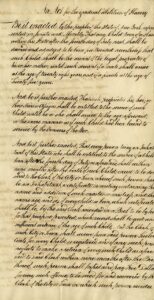
An Act for the Gradual Abolition of Slavery, 1799, NY State Archives Partnership Trust
In 1817, New York enacted full emancipation at the urging of Governor Daniel Tompkins, a member of the Manumission Society. However, the law delayed freedom again. The enslaved born before 1799 were freed on July 4, 1827. The children of enslaved mothers born between 1799 and 1817 would continue indentured service under the 1799 law. And children of the enslaved born between 1817 and 1827 would be indentured servants for twenty-one years, which allowed servitude until 1848.[60] Additionally, enslavers s from other states could bring enslaved persons for nine months, fugitives could be returned to their enslaver, and free people still had to contend with kidnapping.[61]
After 1800, the numbers of the enslaved and enslavers in the city declined and slaveholding became a display of wealth for many.[62] Mayors, still among the wealthiest men in the city, continued to have enslaved persons until at least 1820 and free people who were more than likely indentured servants into the 1840’s.
Marinus Willett and Sixty-Fourth Mayor Isaac Varian had enslaved people in their houses in New York City in the 1820 census.[63] Philip Hone, Fifty-Sixth Mayor Stephen Allen, Fifty-Seventh and Fifty-Ninth Mayor William Paulding, Jr., and Sixtieth Mayor Walter Bowne had freed people in their houses in the 1840 census.[64] In 1850, Philip Hone’s New York City house had Moses Price, a Black male waiter, 27 years old, Rachel Brown, a Black forty-five year old woman from Maryland, and Jane Sloane, 33 years old, from Ireland.[65] It is likely that Moses was a free man who had served as an indentured servant for Hone.
Even after emancipation, there were two mayors in office with direct connections to slavery, which brings the total with personal involvement in slavery up to forty-five. Isaac Varian was mayor from 1839-41. Sixty-Seventh, Seventieth, and Eighty-First Mayor William Havemeyer, whose final mayoral term ended in 1874, made a fortune in his family’s sugar refinery that directly imported sugar from plantations in Cuba.[66] Additionally, Bowne and Paulding, who had freed people in their houses, are not listed as enslavers in census records but, based on ages and family history of enslavement, the free people were likely former enslaved people laboring as indentured servants under the terms of the 1799 gradual emancipation law.
Black Community in New York as Slavery Declines
After 1800, a free Black community formed. By 1800, over half of the Black population was free and more than eighty percent in 1810,[67] when free Blacks were more common than the enslaved as household servants.[68] Blacks lived among whites, although many had rooms in the unsanitary cellars of buildings, just as they had as enslaved people, and rented rooms in boarding houses.[69]
Free Blacks mainly lived in the north part of the city, with communities around churches, including the John Street Methodist Episcopal Church.[70] In 1795, Black members of that church split off to form their own congregation, which became the African Methodist Episcopal Zion Church.[71] Between 1796 and 1826, New York City Blacks founded ten churches because established churches usually refused Blacks as equals.[72]
However, as Blacks formed their own institutions they faced violence. Beginning in March 1807 and over the next decade, the trustees of the African Methodist Episcopal Zion Church wrote complaints to the Common Council requesting a watchman due to services being disturbed by “boys and unruly persons,” and a trustee of the church reimbursed the council for a watch house.[73] Newspapers carried stories of violence, including boys breaking windows in April 1808 and three young men who, during the summer and fall of 1813, ran into parishioners returning home “as if through accident, and at the same time, gave them a few blows with their fists,” while “their greatest rage seems to be directed against the congregation of the African Church, especially the female part.”[74] An enslaver also complained in a runaway notice that his enslaved person was seen in the church and “was said to be there much agitated with religious exercise.”[75]
Some free men and women were able to use their skills as artisans to become paid laborers, although they were often excluded from workshops. Men spent much of their time on the streets looking for work or performing labor and were the only ones who would empty privies into the river off the nearest dock.[76] They also worked such jobs as carpenters, coopers, butchers, sailmakers, or tailors. Women worked as seamstresses, milliners, and laundresses.[77] Some owned oyster cellars, restaurants and dance halls.[78] However, most worked as domestic servants. Men often worked as waiters and women as washers, with both working as fruit and vegetable peddlers. The highest paid work was often at sea, with men as stewards or cooks and women as maids.[79]
Resistance grew to Black political power. In 1826, New York enacted universal suffrage for white men age twenty-one, but still required Black men to own property worth $250, be “over and above all debts and incumbrances,” a citizen for three years, and a taxpayer to vote. In 1821, one hundred and sixty-three Blacks voted in New York City, but in 1826 only sixteen were eligible to vote.[80]
Frustration of the Black community about people being taken out of the city led to violence. In August 1801, over two hundred Blacks fought with night watchmen at the house of an enslaver who sought to transport her enslaved persons to Virginia. Twenty-three Blacks were arrested and sentenced to sixty days in jail.[81] In June 1819, a slave catcher was confronted by Black men and took refuge in City Hall.[82] In September 1826, as a court in City Hall heard a case to return an enslaved family to Virginia a large group of Black men and women gathered. Mayor Philip Hone “complained of this tumultuous assemblage” and ordered constables to disperse the crowd.[83] After the slave catcher won the case, Blacks threw bricks, sticks, and stones at him. Nearby, Black men chased a white man and cried “kill him, kill him.” Four Black men were arrested and received harsh sentences, including three years hard labor.[84]
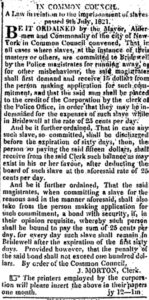
National Advocate, July 12, 1821, notice of law allowing enslaved to be held at Bridewell
Persistence of Slavery’s Power
Black political power and the influence of the Manumission Society waxed and waned in New York City on the issue of the imprisonment of the enslaved in Bridewell, the city prison that stood in today’s City Hall Park.
In colonial times, the enslaved could be imprisoned indefinitely. In November 1731, the Common Council decreed that enslaved persons could be apprehended by colonists and committed to prison for a crime until the enslaver paid a reward.[85] In March 1736, the council approved holding “all unruly and ungovernable servants and slaves” in the newly built Workhouse and House of Correction, the first city almshouse, “to be kept at hard labour and punished” by a justice with consent of the enslaver, who also had to pay to hold the enslaved there and for whipping them. There was no limit on how long the enslaved could be there.[86]
This continued after the revolution. The rules of Bridewell prison, enacted in 1784, did not allow for servants or the enslaved to be confined. However, in July 1790, under Mayor Richard Varick, the council decreed that servants or enslaved people could be sent to Bridewell.[87] A Manumission Society report stated that enslavers committed the enslaved for trivial offenses and they were confined for months in an “abode of wretchedness and misery.”[88] And, in 1801, the council received a letter from citizens “against the practice of confining Slaves in the Bridewell on the Application of Persons claiming the Ownership of them.” [89]
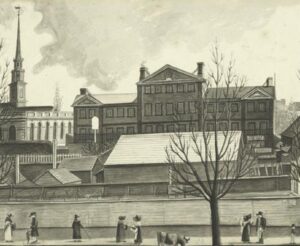
Bridewell, and Charity-School, Broadway, opposite Chamber Street, 1808, NYPL
In January 1804, Mayor DeWitt Clinton and the council received a letter from the Manumission Society urging that enslaved people not charged with criminal offenses no longer be confined in prison. Those reforms were voted down.[90] However, in February 1805, Clinton presided as mayor while the council passed a law that the enslaved could be confined only with the order of a magistrate. No time limit was placed on confinement if the enslaver paid expenses. [91] In June 1807, Mayor Marinus Willett presided over the council that passed the same law.[92]
In 1813 and 1814, the Black community and Manumission Society achieved reforms. On April 6, 1812, the council again approved allowing enslavers to commit the enslaved with the approval of a magistrate.[93] However, in January 1813, Clinton and the council received a letter from the Manumission Society that criticized the policy of confining the enslaved in Bridewell and urged a new law.[94] In March 1813, Clinton presided over the council passing an ordinance that the enslaved could be committed to Bridwell by a magistrate for up to sixty days at the expense of the enslaver.[95] On December 1813, the “People of Colour of the City and County of New York” wrote a letter to the mayor and aldermen, stating their “extreme dissatisfaction” of the law. They stated that the enslaved should be “tried and convicted in a court of justice” before confinement.[96] In March 1814, the council repealed the 1813 law after considering the letter.[97]
However, the imprisonment of the enslaved continued. In February 1818, the council passed a law allowing enslaved persons to be confined for running away or “for other misbehavior” for up to sixty days. It required magistrates to receive fifteen dollars before ordering the enslaved to prison and expenses were twenty-five cents a day for imprisonment.[98]
In 1818, Cadwallader Colden, a former enslaver, was mayor and president of the Manumission Society when the law was repealed. On August 24, Colden remarked to the council if it could be “ascertained by what authority the City Prison is rendered subservient to the authority of slave holders.”[99] On September 28, the council found that the 1812 law had expired but the confinement of the enslaved continued “without authority in so shameful and oppressive a degree that it has become common to receive the already miserable slave in our Bridewell without a commitment or complaint but merely the assertion of oppressive tyranny or the wanton desire of hardened cruelty.” The law was changed so that the enslaved could only be imprisoned for a crime and those brought without a magistrate’s order would be discharged after three days.[100]
However, there were limits to Black political power and the influence of the Manumission Society. In July 1821, under Mayor Stephen Allen, the council passed a law that allowed enslaved people to be held in Bridewell for over sixty days for “running away or for other misbehaviour” if the enslaver put up a bond. It is unclear how long the law was enforced.[101]
Next: New York Abolition
_______________________________________________________________________________________________________________________
[1] “The Neighborhoods of New York, 1760-1775,” Carl Abbott, New York History, Vol. 55, No. 1, Jan. 1974, pp. 41, https://www.jstor.org/stable/23169562
[2] Revolutionary Conservative, p.156
[3] Revolutionary Conservative, p.100
[4] Gotham, p.224; “Articles of Association,” Committee of One Hundred, online; NYS History Museum, for Albany has “ never to become Slaved”
[5] Revolutionary Conservative, p.158-59
[6] Emancipating New York: The Politics of Slavery and Freedom, 1777–1827, David N. Gellman, 2006, Introduction
[7] “New York’s Earliest Mayors,” Kenneth R. Cobb, NYC Archives, link
[8] MCC, 1784-1831, Vol. I, pp.513-514
[9] “New York as an Eighteenth-Century Municipality,” George W. Edwards and Arthur Everett Peterson, 1912 pp.223-24; MCC, 1784-1831, Vol. VI, p.61-64: council voting on petition to the legislature on Feb. 5, 1810, p.236: council approves $7,000 salary of mayor on June 11, 1810, p.236 ; The charter of the city of New York, with notes thereon…, James Kent, 1851, p.251
[10] Public Property and Private Power, p.92-93; Gotham, p.267
[11] Public Property and Private Power, p.94-95, 130-105
[12] Gotham, p.333 and 338
[13] Revolutionary Conservative, p.53
[14] P.R. Maverick plan, New York Public Library, link
[15] Chants Democratic, p.35
[16] New York Directory, 1786, Internet Archive, pp.61; link;
[17] Gotham, p.333
[18] Gotham, Kindle, p.xvii
[19] Gotham, Kindle p.333-34; “The Slave Insurance Market: How much did slave owners pay for antebellum-era policies from Aetna, AIG, and New York Life?,” Foreign Policy, Michael Ralph and William Rankin, January/February 2017, link
[20] Gotham p. 335
[21] Gotham, p.302
[22] Somewhat More Independent, p.25
[23] Gotham, p.306
[24] Gotham, p.275
[25] In the Shadow of Slavery, p.54
[26] In the Shadow of Slavery, p.53
[27] History of Negro Slavery in New York, p.154-159
[28] In the Shadow of Slavery, p.55; Emancipating New York, Ch.1-2
[29] “Slavery in New York State in the Early Republic,” Shane White, Australasian Journal of American Studies, Vol. 14, No. 2 (December, 1995) pp.2, https://www.jstor.org/stable/41053779
[30] Somewhat More Independent: The End of Slavery in New York City, 1770-1810, p.4. White lists his reasoning on why the U.S. census numbers are wrong on pp. xxv-xxvi
[31] Somewhat More Independent, p.31
[32] Gotham, p.313
[33] Gotham, p.336
[34] Somewhat More Independent, p.4-5
[35] Somewhat More Independent, p.9
[36] Somewhat More Independent, p.11-13
[37] Somewhat More Independent, p.35-36
[38] MCC, 1784-1831, Vol. I, pp.1
[39] MCC, 1784-1831, Vol. I, pp.11; Emancipating New York, Ch.3
[40] “The New York Packet and the American Advertiser,” March 11, 1784
[41] “The New York Packet and the American Advertiser,” March 8, 1784, Emancipating New York, Ch.3
[42] MCC, 1784-1831, Vol. I, p.68
[43] MCC, 1784-1831, Vol. I, pp.12; “New York Packet,” March 22, 1784, Emancipating New York, Ch.3
[44] MCC, 1784-1831, Vol. I, pp.80; “New York Packet,” May 3, 1784, Emancipating New York, Ch.3
[45] Emancipating New York, Ch.8
[46] Somewhat More Independent, p.85
[47] In the Shadow of Slavery, p.49, 63; “John Teasman: African-American Educator and the Emergence of Community in Early Black New York City, 1787-1815,” Robert J. Swan, Journal of the Early Republic, Vol. 12, No. 3, pp. 331-356 https://www.jstor.org/stable/3123834
[48] Gateway to Freedom, p.42; “Dating the Start and End of Slavery in New York,” Ned Benton, link
[49] Before the Melting Pot, p.117
[50] “A History of the New York Manumission Society, 1785-1849,” Thomas Robert Moseley, p.129
[51] “A History of the New York Manumission Society, 1785-1849,” p.133; Root and Branch, Ch.2
[52] Abstracts of Wills on File in the Surrogate’s Office, 1665-1801, Vol.1, p.339-340, FamilySearch
[53] Abstracts of wills on file in the Surrogate’s Office, City of New York, 1665-1801. V. 2, p.14-15, FamilySearch
[54] Douma, Michael. “Prices of Enslaved Persons in New York and New Jersey.” Journal of Slavery and Data Preservation 4, no. 5 (2023): 67-75, https://doi.org/10.25971/n839-9r79; Revolutionary Conservative, digital edition, p.186, 215-220, 231; Arthur Alexander, “Federal Officeholders in New York State as Slaveholders, 1789-1805” The Journal of Negro History, (1943), Vol. 28, No. 3, p.336, on JSTOR
[55] Yoshpe, p.84
[56] “Record of Slave Manumissions in New York During the Colonial and Early National Periods,” Harry B. Yoshpe, p.91 and New York City Conveyances, 1809–1810, viewer p.489, and 1811-1812, viewer p.618, FamilySearch
[57] Act for the Gradual Abolition of Slavery, National Archives, link
[58] Gateway to Freedom: The Hidden History of the Underground Railroad, Eric Foner, 2015, p.42-44
[59] The first emancipation : the abolition of slavery in the North, Arthur Zilversmit, 1967, p.182-184; In the Shadow of Slavery, p.70; Emancipating New York, Ch.8
[60] In the Shadow of Slavery, p.94
[61] In the Shadow of Slavery, p.7, 207-212; African or American?, p.34-35
[62] Somewhat More Independent, p.46
[63] Willet: FamilySearch, NYC Ward 10, Schenectady Ward 2, 1820 Census; Varian: FamilySearch, 1820 Census, Issac L. Varian, NYC Ward 9
[64] 1840 Census: Allen: New York City Ward 15; Bowne: “Walters Bowen,” New York City Ward 2; Hone: New York City Ward 15; Paulding, Jr.: New York City Ward 5, Ancestry.com
[65]1850 Census, New York Ward 15 Eastern Half, Ancestry.com
[66] Gotham, p.660; Sugar and Columbia University · Student Exhibits | Columbia University and Slavery; Landmarks Preservation Commission, Sept. 25, 2007; Designation List 396, LP-2268, report; “Relics of the Domino Sugar Refinery, Frozen in Time and Syrup,” New York Times, Oct. 23, 2013; Sugar imports from Cuba: Shipping and Commercial List, Wednesday, July 17, 1839, p.4, July 31, 1839, p.4; New-York Commercial Advertiser, Friday, Aug 13, 1841, p.2
[67] Gotham: A History of New York City to 1898, Kindle p.347; Many Thousands Gone: The First Two Centuries of Slavery in North America, Ira Berrlin, 1998, table p.374-5.
[68] Somewhat More Independent, p.50-51
[69] Somewhat More Independent, p.178; In the Shadow of Slavery, p.76
[70] Somewhat More Independent, p.172-173
[71] In the Shadow of Slavery, p.76
[72] In the Shadow of Slavery, p.82
[73] MCC, 1784-1831, Vol. 4, pp.389; Vol.7, p.729; Vol.10, p.40: paying for watch house: MCC, Vol.5, pp.278; Vol.6, pp.271, 501, 684; African or American?, p.31; Road to Mobocracy: Popular Disorder in New York City, 1763-1834, p.172
[74] New-York Commercial Advertiser, Thursday, Apr 28, 1808; American Citizen, Thursday, Apr 28, 1808; The Columbian, Wed., Nov 10, 1813
[75] New-York Gazette & General Advertiser, Monday, Jan 06, 1806
[76] The sounds of slavery: Discovering African American history through songs, sermons, and speech, Shane White, 2005, p.154-156
[77] City of Women: Sex and Class in New York, 1789-1860, Christine Stansell, 1987, p.12-13
[78] In the Shadow of Slavery, p.77-80; City of Women, p.14-15
[79] In the Shadow of Slavery, p.79
[80] In the Shadow of Slavery, p.50, 118, 132, 1821 New York Constitution, link; Reports of the proceedings and debates of the convention of 1821, assembled for the purpose of amending the constitution of the state of New York, pp.198-199; “The Free Negro in New York,” Leo H. Hirsch, Jr., The Journal of Negro History, Vol. 16, No. 4 (Oct., 1931), pp. 417
[81] Road to Mobocracy, p.165-168; The New-York Gazette and General Advertiser, Monday, Aug 24, 1801
[82] Road to Mobocracy, p.168-169
[83] The New-York Evening Post, Thursday, Sep 21, 1826, Road to Mobocracy, p. 168-170
[84] Road to Mobocracy, p. 168-170, African or American? p.34-35
[85] MCC, 1675-1776 v.4 1730-1740, p.90, link
[86] MCC, 1675-1776 v.4 1730-1740, p.310-311, link; “The Slave Code in Colonial New York,” Edwin Olson, The Journal of Negro History, Vol. 29, No. 2 (Apr., 1944), pp. 164, https://doi.org/10.2307/2715308
[87] MCC,, 1784-1831 v.1 1784-1793, p.559 and 563, link; Rules governing Bridewell passed on June 16, 1784. P.48-51; “The Slave Code in Colonial New York, pp. 164
[88] “The Slave Code in Colonial New York,” pp. 164
[89] MCC, 1784-1831, v. 3, pp.16
[90] MCC, 1784-1831 v.3 1801-05, pp.440
[91] MCC, 1784-1831 v.3 1801-05, pp.691, link
[92] MCC, 1784-1831 v.4 1805-08, pp.435, link; Republican Watch-Tower, June 2, 1807, p.3
[93] MCC, 1784-1831 v.7 1812-14, pp.98, HathiTrust, link; Laws and ordinances…passed during the mayoralty of De Witt Clinton, pp.186-187, Hathi Trust, link
[94] MCC, 1784-1831 v.7 1812-14, pp.343-44, HathiTrust, link NYPL, Longworth’s New York City Register, 1812-1813, pp.42: Cadwallader Colden is president and Willet Robins is listed as “chairman of standing committee”
[95] MCC, 1784-1831 v.7 1812-14, pp.386, HathiTrust, link; The Columbian, Wednesday, March 17, 1813, p.3; Commercial Advertiser, Wednesday, Mar 17, 1813, p.3
[96] MCC, 1784-1831 v.7 1812-14, pp.645, HathiTrust, link; NYC Archives, December 27, 1813, Minutes of the Common Council, link;
[97] MCC, 1784-1831 v.7 1812-14, pp.711, HathiTrust, link; The Columbian, Wednesday, Apr 06, 1814, p. 3
[98] MCC, 1784-1831 v.9 1817-18, pp.494-95, link; The New-York Evening Post, Thursday, Feb 19, 1818, p.3
[99] MCC, 1784-1831 v.9 1917-18, pp.765, link
[100] MCC, 1784-1831 v.10 1818-20, pp.38-40, HathiTrust, link; “The Slave Code in Colonial New York, pp. 164-165
[101] MCC, 1784-1831 v.11 1820-21, pp.725, HathiTrust, link; The National Advocate, Thursday, Jul 12 and Friday, July 27, 1821; New-York Gazette & General Advertiser, Friday, Jul 13, 1821
Copyright 2025 Paul Hortenstine

This entry is licensed under a Creative Commons Attribution-NonCommercial-NoDerivatives 4.0 International license.

