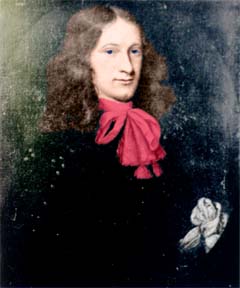
Wilhelmus Beekman, c. 1645, Gerard van Honthorst
William Beekman (Wilhelmus/Willem Beeckman/Veesteman), Acting Mayor 1681-1683: Beekman (1623 –1707) was the progenitor of the prominent Beekman family and deputy mayor of New York and acting mayor from 1681 to 1683. He also served in the Dutch government when they retook the colony from 1673 to 1674 as a schepen (official who was both an alderman and a judge) in 1673 and a burgomaster (similar to mayor with two men holding the office) in 1674. Several streets in New York are named for him or his descendants, who were involved in the slave trade.
In 1646, he departed Amsterdam with Peter Stuyvesant on the Prinses Amelia. He came to New Amsterdam as a clerk in the Dutch West India Company or a private trader. In 1659, he is identified as a Vice-Director of the West India Company and led the company in the Delaware River region. Beekman served in many offices in New Amsterdam, including burgemeester (office similar to mayor with two men serving) in 1673. He participated in West Indies smuggling, exporting commodities, shipbuilding, and built mills and breweries.[1]
He purchased property in Harlem and made several other investments in vast amounts of land. From the editor of the Beekman family papers:
By 1658, when his court actions were concluded, William Beekman was a prosperous family-man of thirty-five. Although he was far less wealthy than many of his political confréres, he held properties at Corlaer’s Hook and in Harlem as well as the land on which his house stood, the north side of the present site of Chatham Square. He was also a brewer, as were many of the town’s leading citizens, and the proprietor of a flour mill. There were further indications of his standing in the community in that he was a slave-owner and a leader of the militia.[2]
On April 4, 1667, a court case shows that Beekman sold an enslaved person for fifty-five beaver skins after granting a mortgage on the enslaved person:
On this April 4th N.S. of the year 1667 appeared before me, Mattheus Capito Secretary of the village of Wildwyck, and the below named witnesses the worthy Reynier Van der Coele who declares to be actually in debted to the hon. Heer Willem Beeckman for the amount of fifty five good whole beaver skins, the before named amount being the balance of the purchase money for a negro. On this account the said appearer promises to pay the said quantity of fifty five good, whole beaver skins to the said hon. Heer Willem Beeckman without cost or expense on June 15th of this aforesaid year. [He mortgaged property to cover this claim][3]
On October 4, 1667, a court found that Beekman should be paid twenty-one beavers for the balance of the sale of enslaved people: “Willem Beeckman Complt. v.s. Reyner Van Coelen Deft. Complt demands of deft 21 whole beavers, balance of a note for the sale of negroes, with costs. Deft admits owing only 20 to complt. The hon. court orders deft to pay complt 20 good beavers, with costs.”[4]
Other connections to slavery:
- He had enslaved people transported into New Amsterdam on the captured Spanish ship Anthoni in 1652.[5]
- In August 1656, Beekman had an enslaved man Fernando, who was part of a large number of enslaved people brought to New Amsterdam by Geurt Thysen (Tijsen).[6]
- In August 1664, Beekman took custody of enslaved people from the Den Gideon who were sent to Fort Altena (Delaware) from New Amsterdam by Stuyvesant. Two hundred ninety enslaved persons were transported to New Amsterdam. He was an official of the Dutch West India Company at the time.[7]
- In May 1683, while serving as deputy mayor, he was officially responsible for overseeing payment for “thirty-eight negro slaves” who were waylaid in New York after traveling from Angola to Nevis.[8]
- In his 1701 will, Beekman left his maid, Rachel, a lot of land and frees her at age thirty-one.[9]
From Beekman’s letters to Director Stuyvesant:
- October 26, 1661: While in New Amstel, “The English offered to transport yearly 2 or 3000 hogsheads of tobacco to our stream or Apoquenemingh, if they were supplied with Negroes and other merchandise.”[10]
- March 20, 1662: While in New Amstel, “My Lords, I respectfully request that you send me a Company Negro; I require one to perform various services.”[11]
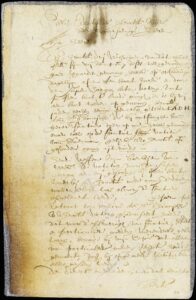
Letter from William Beeckman to director Stuyvesant, March 20, 1662, NY State Archives
[1] Merchants and Empire, p.98, 261, 425 n.42; New Amsterdam officeholders are in The register of New Netherland, 1626 to 1674, starting on p.58
[2] The Beekmans of New York in politics and commerce, 1647-1877, White, Philip L., 1956, p.33; White was an editor of the papers
[3] Ulster County Archives, Dutch court records of Wiltwyck 1661-1709, case
[4] Ulster County Archives, Dutch court records of Wiltwyck 1661-1709, case
[5] “Burghers and Blacks,” p.132
[6] Documents relative to the colonial history of the State of New York…, v.2, p.81, referred to as Vice-Director on p.76, 112; New Amsterdam History Center, Mapping New York, has records for Jochem Beeckman in New Amsterdam by November 1652, link, but he does not appear to have owned any slaves; William Beeckman, link; on the shipment by Geurt Thysen: Document: Resolution of director and council adhering to their previous resolution regarding the claim of Juan Gallardo Ferara, New Amsterdam History Center, link
[7] Bound by Bondage, p.50-51; Trans-Atlantic Slave Trade Voyages Database, #11414
[8] Abstracts of wills on file in the Surrogate’s Office, City of New York, 1665-1801, Vol II, 436; “Bound by Bondage…,” dissertation by Nicole Saffold Maskiell, 2013; Trans-Atlantic Voyage ID #21558
[9] Abstracts of wills on file in the Surrogate’s Office, City of New York, 1665-1801. V. 2, p.14-15, FamilySearch
[10] NY State Archives, translation, link
[11] NY State Archives, translation, link
Copyright 2025 Paul Hortenstine

This entry is licensed under a Creative Commons Attribution-NonCommercial-NoDerivatives 4.0 International license.

