
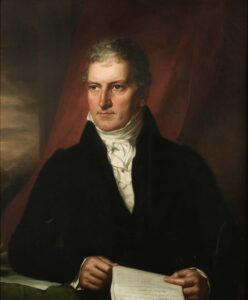
Phillip Hone by John Vanderlyn, 1827, NYC City Hall Portrait Collection
Philip Hone, Mayor 1826-1827: Hone (1780 – 1851) co-owned an auction house with his brother John that made both tremendously wealthy and Philip retired at age 40. They auctioned cargo that arrived from through the port, including tea. Philip is also known for his extensive diaries.
Hone had free persons in his household in 1816 and 1820 censuses who were likely now indentured servants. Hone had four free persons in his New York City household—two men and two women—and the men were there until at least 1830. One man and woman were born between 1795 and 1806 and the other man and woman between 1776 and 1794.
In February 1809, Philip Hone manumitted an enslaved woman, Charlotte.[1] From the conveyance record
“I Philip Home of the State of New York Do by these presents for good and valuable considerations fully and absolutely manumit make free Y and set at liberty my Black Slave named Charlotte hereby willing and declaring that the said Charlotte shall and may at all time and times hereafter exercise hold and enjoy all and singular the liberties Rights privileges and immunities of a free Woman as fully to all intents and purposes as if she had been born free and I do hereby for myself my Executors administrators and assigns absolutely relinquish and release all my right title and property whatsoever in and to the said Charlotte as a slave.”[2]
Directories of the city list Philip and his brother John as merchants from 1800 onward. Not until the directory of 1811-12 is there a Philip S. Hone who is also a merchant. There is also a Philip J. Hone, who is the mayor’s nephew. Philip S. Hone died sometime in 1818.[3]
- 1810 Census: three Philip Hones in New York City. None with enslaved persons. The one in Ward 3 that is the future mayor had nine total people in his household, including four “other free persons, except Indians, not taxed”
- 1816 jury census: no enslaved people, one male and two female “colored inhabitants, not slaves.” There are thirteen people total in the household at 44 Courtland Street.[4]
- 1820 Census: four “free colored persons.” One male, 14 thru 25; one male, 26 thru 44; one female, 14 thru 25; one female, 26 to 44
- 1830 Census: two “free colored persons” who are males of 24 and under 36.[5]
- 1840 Census: New York Ward 15, Philip Hone had “free colored persons:” one male (age 10-23), two males (24-35), and one female (10-23).[6]
1850: In Philip Hone’s household: Moses Price, male, Black, waiter 27 years old.[7]
[1] Northeast Slavery Records Index; Yoshpe, p.84
[2] New York City, New York, United States records, image 70 of 754; New York. County Court (New York County), FamilySearch; Despite there being another Philip Hone during this time period, the evidence points to Mayor Hone manumitting a slave. His brother, John (1764-1832), was an enslaver in the 1800 and 1810 census. He or their father, John (Johan) Philip Hone, was an enslaver in the 1790 census. His brother manumitted a slave named George in 1808.
[3] New York Public Library, digital collections, New York City Directories; New York, U.S., Wills and Probate Records, 1659-1999, Wills, Vol 054, 1816-1818, Philip S. Hone, Probate Date: 15 Jul 1818, Ancestry.com
[4] NYC Archives, New York Jury Census, Volume 3, Ward 3, 1816, link; also a Philip T. Hone, merchant, and Philip Hone, baker; Courtland Street matches city directory
[5] 1810, 1820, and 1830 census from Ancestry.com; Hone listed as in Ward 3 in 1824, link
[6] 1840 Census search, Ancestry.com
[7] 1850 Census search, New York Ward 15 Eastern Half, Ancestry.com
Copyright 2025 Paul Hortenstine

This entry is licensed under a Creative Commons Attribution-NonCommercial-NoDerivatives 4.0 International license.

