
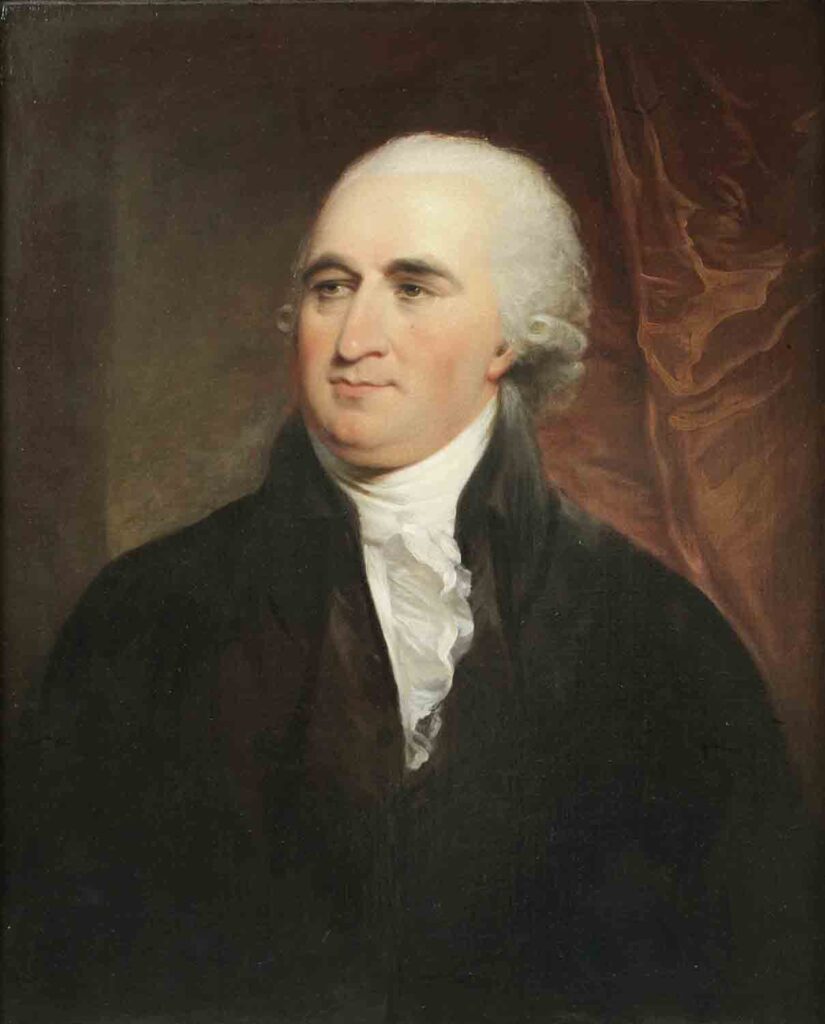
James Duane by John Trumbull, 1805, NYC City Hall Portrait Collection
James Duane, Mayor 1784-1789: Duane (1733 – 1797) is considered a founder and attended the Continental Congress. He is also one of the founders of the New York Manumission Society and an enslaver. Duane also owned significant portions of land in Vermont and created the township of Duanesburgh in 1794. He and his family moved from the city to a farm there in 1794.
In 1789, Duane’s taxable wealth was $8,125. At that time, taxable wealth was real and personal property recorded on assessment lists. For the five years Duane held office, his annual income was about $2,000. At that time, the mayor “was not paid a salary, but was instead permitted to personally collect most of the licenses and fees paid to the city, an extremely lucrative source of income.”[1]
- In the 1790 census, Duane is listed as having one enslaved person in his household in New York City.
- In November 1792, Duane bought Dan, (Daun), age 25, from Melanchton Smith for thirty pounds on the condition that Dan be manumitted in five years.
- In 1794, James Duane bought an enslaved woman, age 32, and from Henry Putnam. Her two young children were also enslaved. An entry in his journal is to the effect that “‘he promised her in case of good behavior to free her in twelve years and her son at twenty-eight years.’ The Judge [Duane] had no scruples about separating a slave mother from her child, for less than a year later he sold the mother along with a two months’ old female child, which had been born in the interim, for £40 to a Mr. Sam Thorpe upon condition that the mother be released at the end of ten years and the female child at the age of twenty-eight. The Judge retained the son with the intention of himself manumitting him at the promised age.”
- Duane’s enslaved man Sam broke into a house and stole some sugar, for which he received fifteen lashes.[2]
Duane’s wife, Mary Livingston (1738–1821), was from the prominent Livingston family and a direct descendant of major slave traders. Her grandfather, Philip Livingston (1686 – 1749), and father, Robert (1708–1790), were investors in multiple slave ships. Robert was Duane’s guardian and Duane and his wife were married at Livingston Manor, where they spent a great deal of time. When his wife inherited two enslaved persons from her father, Duane manumitted them: “When Mrs. Duane’s father’s personal estate was divided among his heirs in August, 1791, ‘two black servants’ valued at £5-15-0 fell to Mrs. Duane’s lot and were quickly manumitted.”[3]
[1] Democratic Dividends: Stockholding, Wealth and Politics in New York, 1791-1826, Eric Hilt and Jacqueline Valetine, NBER Working Paper, link
[2] Douma, Michael. “Prices of Enslaved Persons in New York and New Jersey.” Journal of Slavery and Data Preservation 4, no. 5 (2023): 67-75; census: New York City North Ward, New York, New York; James Duane: Revolutionary Conservative, Alexander, Edward P., 2019 digital edition, p.186, 215-220, 231; Arthur Alexander, “”Federal Officeholders in New York State as Slaveholders, 1789-1805″” The Journal of Negro History, (1943), Vol. 28, No. 3, p.336, on JSTOR
[3] Arthur Alexander, “Federal Officeholders in New York State as Slaveholders, 1789-1805” The Journal of Negro History, (1943), Vol. 28, No. 3, p.336, on JSTOR; James Duane: Revolutionary Conservative, Alexander, Edward P., 2019 digital edition, p.186, 215-220, 231; Northeast Slavery Records Index
Copyright 2025 Paul Hortenstine

This entry is licensed under a Creative Commons Attribution-NonCommercial-NoDerivatives 4.0 International license.

