
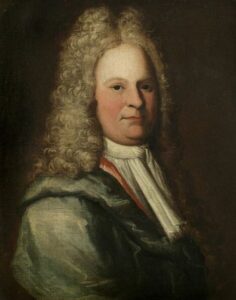
Caleb Heathcote, artist unknown, c. 1710-1715, The New York Historical
Caleb Heathcote, Mayor 1711-1714: Heathcote (1665 – 1721) was a merchant and investor in a ship that transported the enslaved. He engaged in piracy, the fur trade, the West Indies trade, dry goods trade, and imported from the Antilles, Madagascar, Madeira. He invested in mills in New York.[1]
Heathcote invested in many ships in the illegal Madagascar and Indian Ocean trade. He co-owned the Nassau with Stephen Delancey, and the captain was the well-known pirate Giles Shelley.[2] Captives purchased at Madagascar were transported from the Nassau to shore at Cape May and Red Hook to avoid British authorities. In 1694, he also owned part of ship that Captain Richard Glover sailed from New York to Barbados, and then to Madagascar (the cargo of this voyage is unclear).[3]
Governor Fletcher sold a ship to Heathcote in 1693 or 1694, which previously belonged to the pirate William Mason. The ship is the Jacob, which engaged in trade with Madagascar prior to the sale but its voyages under Heathcote’s ownership are uncertain.[4] Another business partner was Captain John Evans, a naval officer who ostensibly tried to stop smuggling and piracy in New York harbor in the boat H.M.S. Richmond. but worked for Governor Fletcher to allow some pirates to use the port.[5]
Heathcote was both the mayor and the presiding judge in the trial of the enslaved accused of violent revolt in 1712. Twenty-one were executed, including being burned alive, hanged, or broken at the wheel, and six committed suicide. Heathcote was repaid for expenses related to their executions: “The mayor and his colleagues appropriated the sum of £36 0s 10d the grim account informs for irons gibbets cartage labor firewood and other materials and expenses for the executing of several Negro slaves for Murders by them committed April last.” Afterwards, New York’s legislature enacted more stringent slave codes.[6]
In 1697, he received a land grant from Governor Fletcher and purchased another property that he developed into Scarsdale Manor. There were slave quarters and at least ten enslaved people along with indentured servants in his manor house. In 1710, It appears Heathcote had an indentured servant from Europe, an orphan named Hans Feliacoons.[7]
Slaveship Investment
| Ship | Dates of Voyage | Ports of Call | Enslaved Purchased | Cargo | Co-Investor |
| Nassau | 7/7/1698 | To Madagascar; offloaded at Cape May and Red Hook | 23 | 70 pirates, muslin, opium, calicoes, opium, ivory, 12,000 pieces of eight, 3,000 [Dutch] “lyon dollars,” other cargo | Stephen Delancey |
[1] Merchants & Empire, p.61,77, 96, 151
[2] Pirates, Merchants, Settlers, and Slaves, p.52, 58
[3] The Attorney General of New York’s memorial about Glover the pirate, May 5, 1699, CO 5/104, pp.222
[4] Documents Relative to the Colonial History of the State of New York, Vol. IV, pp.307; Report upon the general state of the Province of New York, 1698 outlining various affairs relating to piracy, illicit trade and land grants, CO 5/1079 Part 1, 013, pp.39-43, digital p.3-7; Pirates, Merchants, Settlers, and Slaves: Colonial America and the Indo-Atlantic World, Appendix I: Table of Slave Ships in Madagascar 1663-1747
[5] Calendar of state papers, Colonial series…, Vol.16 (1697-1698), pp.183
[6] When I Die I Shall Return to My Own Land, Kindle, p.195
[7] New York, Probate Records, 1629-1971, New York, Wills 1718-1724 Vol. IX, April 9, 1721, image p.179, numbered 233, FamilySearch; Abstracts of wills on file in the Surrogate’s Office, City of New York, 1665-1801. V. 2, p.233, FamilySearch; Recognizing Enslaved Africans of Larchmont Mamaroneck, List of Enslavers and Enslaved; Caleb Heathcote, Gentleman Colonist…, Dixon Ryan Fox, 1926, p.111-115 and quote from p.133; Heathcote’s will in Early wills of Westchester County, New York, from 1664 to 1784; Names of Palatine Children, from Documentary History of the State of New York , E.B. O’ Callaghan, Volume 3 Chap IX, p.334
Slaveship: Pirates, Merchants, Settlers, and Slaves, p.52; “The Madagascar Connection: Parliament and Piracy, 1690-1701;” CO 5/1042, 98, 243
Copyright 2025 Paul Hortenstine

This entry is licensed under a Creative Commons Attribution-NonCommercial-NoDerivatives 4.0 International license.

