
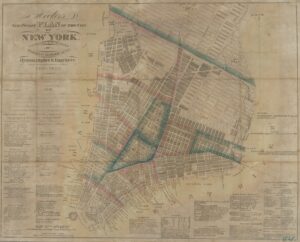
Hooker’s new pocket plan of the city of New York, 1828, NYPL Digital Collections
From 1800 to 1828, DeWitt Clinton inhabited a peak of political power in New York. George Clinton, his uncle, served as governor and was the fourth vice president. DeWitt served in numerous political offices in New York, including New York City mayor three times, U.S. Senate, governor, and lost a close election for president in 1812. One of his best-known achievements as governor is the Erie Canal. His uncle and father were enslavers. So too was Clinton, who tried to reckon with its legacy.[1]
In 1799, Clinton freed Jack but delayed his release from bondage for six years, and he manumitted another enslaved man in December 1810.[2] In 1805, Clinton applied for reimbursement for the abandoned enslaved girl Jenny, and he received $252.[3]
While mayor in 1810, he carried an appeal to the legislature to pass an act of incorporation for the New York African Society for Mutual Relief. Blacks founded this mutual aid society in 1808, and incorporation granted legal status to the group, which was the first and longest standing mutual aid society. Over one hundred members celebrated the event with a parade in New York City with silk banners and signs. [4]
One year later he addressed the New York Historical Society and declared that “the discovery and settlement of America” had “exterminated millions” of Native Americans and “entailed upon the sable inhabitants of Africa, endless and destructive wars, captivity, slavery and death.”[5] However, in 1819 he said that he would not expect from Blacks “many exhibitions of extraordinary virtues or talents.”[6] And, in 1820 Clinton had a man and a woman in his house in Albany who were very likely free people working as indentured servants.[7]
July 4th and 5th, 1827
While Clinton was governor in 1827, New York’s emancipation law went into effect on July 4th. The Black community had two celebrations. The African Society for Mutual Relief held a meeting in their hall, while other societies held meetings and churches held services.[8] The next day, three to four thousand Blacks paraded with bands and banners, in a display of their claims to freedom.[9]
Black abolitionist William Hamilton, a founder of the African Society, delivered a speech at the African Zion Church on July 4.[10] He thanked the prominent New Yorkers who supported manumission, many of them enslavers. But of those who opposed ending slavery, he said, “Let us look at them, and we shall see, with all their pomp, and pride, and hauteur, they are more the objects of pity and commiseration, than of anger and hate. Well may it be said, ‘the wicked are like the troubled sea.’ It is hard breathing in their atmosphere.”[11]
Next: NYC Slavery Timeline
__________________________________________________________________________________________________________________________
[1] The Birth of Empire: DeWitt Clinton and the American Experience, 1769-1828, Evan Cornog, 1998, throughout.
[2] 1800, 1810, and 1820 U.S. Census; “Record of Slave Manumissions in New York During the Colonial and Early National Periods,” Harry P. Yoshpe, The Journal of African American History, January 1941, p.80; in Northeast Slavery Records Index
[3] Northeast Slavery Records Index, citing Comptroller’s Record of Abandonment
[4] In the Shadow of Slavery, p.86; Slavery in New York, pp.224
[5] The life and writings of De Witt Clinton, 1848, p.252, Internet Archive, link
[6] Messages from the governors, comprising executive communications to the Legislature…, Ed. Charles Z. Lincoln, Vol. II, pp.977-978, Hathi Trust, link, “John Teasman,” pp.348 n.40
[7] 1820 U.S. Census, FamilySearch, “Free Colored Persons” one male and female ages 26 thru 44
[8] In the Shadow of Slavery, p.126
[9] In the Shadow of Slavery, p.88, p.126; African or American?, p.58-62
[10] “Organizations of the Free Negro in New York City, 1800-1860,” Daniel Perlman, The Journal of Negro History, Vol. 56, No. 3, pp. 181-2, https://www.jstor.org/stable/2716271
[11] Liberty’s Chain: Slavery, Abolition, and the Jay Family of New York; “An oration delivered in the African Zion Church, on the 4., of July, 1827, in commemoration of the abolition of domestic slavery in this state,” p.11, HathiTrust, link
Copyright 2025 Paul Hortenstine

This entry is licensed under a Creative Commons Attribution-NonCommercial-NoDerivatives 4.0 International license.

