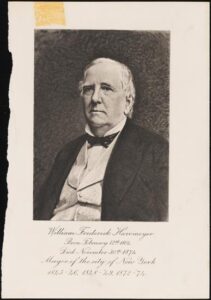
WIlliam Havemeyer, ca. 1860-1890, Museum of the City of New York
William Havemeyer, Mayor 1845-46, 1848-49, and 1873-74: Havemeyer (1804 – 1874) made a fortune from his family sugar refinery and retired from the business in 1842. He headed a refinery on Van Dam Street in lower Manhattan from 1828 to 1842. His father began his own business in 1807, establishing one of the first sugar refineries in New York City. In 1828, he formed a partnership with his cousin, Frederick, under the name of W. F. & F. C. Havemeyer, sugar refiners. In 1842, he sold out his interest in the firm to his brother Albert. The sugar refineries of the Havemeyer family were predecessors to the American Sugar Refining Company, later called the Domino Sugar Corporation, which has the famous building in Williamsburg.
Havemeyer was also the president of the Bank of North America from 1851 to 1861, president of the New York Savings Bank from 1857 to 1861, and vice president of the Long Island Railroad Company and the Pennsylvania Coal Company.
Sugar cane was supplied from the American south, mainly Louisiana, and the West Indies, from the labor of enslaved Africans. Though slavery ended in the United States in 1865, it continued in Cuba, a leading exporter of raw sugar, until 1886, and in Brazil until 1888. Sugar mills were among the earliest factories in North America. Initially operated close to plantations, by the early nineteenth century most were in major commercial centers.
Though Mayor Havemeyer publicly criticized slavery and strongly opposed its expansion, like many New Yorkers he maintained that “no forcible interference” should occur “in states which it already existed.” In 1859, he joined with other wealthy New Yorkers—including William B. Astor, Moses Taylor, and Samuel Tilden—to form the Democratic Vigilant Association, dedicated to opposing Republicans and convincing Southerners that New York merchants could be depended on.[1]
Columbia’s Havemeyer Hall was named after Henry Osborne Havemeyer, one of the third generation of his family to work in sugar refining. He helped create the Sugar Trust and saw its transition into the American Sugar Refining Company in response to 1890 anti-trust laws. Henry and his wife, Louisine, donated a large collection of art that is still on display at The Met.[2]
Newspaper accounts of shipments reveal that his company directly imported sugar from Cuba, which had enslaved labor on sugar plantations.
- March 5, 1828: Forms company and dissolves previous partnership with Frederic C. Havemeyer.[3]
- 1828 Sugar Imports to New York: Cuba, Permanbuco [Brazil], St. Eustasia, St. Thomas, St. Barts, New Orleans, and “Coastwise.”[4]
- July 15, 1839: From Havava, barque Rapid: 122 boxes sugar, W.F. & F.C. Havemeyer[5]
- July 31, 1839: From Havana, the ship St. Thomas: 18 boxes sugar, W.F. & F.C. Havemeyer[6]
- August 1841: Barque Nile Shaw, from Matanzas [Cuba]: 100 boxes sugar: WF&FC Havemeyer[7]
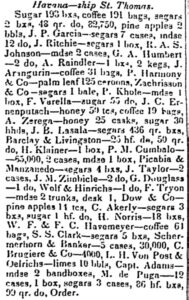
Importation of sugar from Cuba, Shipping and Commercial List, July 31, 1839
[1] Landmarks Preservation Commission, Sept. 25, 2007; Designation List 396, LP-2268, report; Gotham: A History of New York City to 1898, digital edition, p.861; “Relics of the Domino Sugar Refinery, Frozen in Time and Syrup,” New York Times, Oct. 23, 2013, link
[2] Columbia University, Sugar and Columbia University; The Met, Havemeyer Collection
[3] Commercial Advertiser, Saturday, Mar 08, 1828, Page 1, Genealogy Bank
[4] Shipping and Commercial List, Saturday, Jan 10, 1829, p.4, Genealogy Bank
[5] Shipping and Commercial List, Wednesday, Jul 17, 1839, Page 4, Genealogy Bank
[6] Shipping and Commercial List, Wednesday, Jul 31, 1839, Page: 4, Genealogy Bank
[7] New-York Commercial Advertiser, Friday, Aug 13, 1841; Vol:XLIV, Page:2; Genealogy Bank
Copyright 2025 Paul Hortenstine

This entry is licensed under a Creative Commons Attribution-NonCommercial-NoDerivatives 4.0 International license.

