
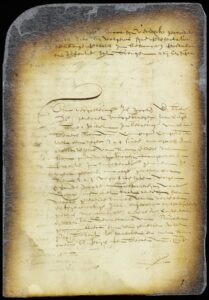
“Order to allow Thomas Willet 3 or 4 slaves with permission to remove them wherever he likes,” September 30, 1660, NY State Archives
Thomas Willett, Mayor 1665-1666 and 1667-1668: Willett (1607 – 1674) was appointed the first mayor on June 12, 1665. Around 1640, Willett began trading with the Dutch in New Amsterdam and acquired property both there and in Fort Orange. He was a merchant, fur trader, and captain of the Plymouth Colony militia. He facilitated trade between Plymouth Colony and New Netherland.[1] By 1650, he had a small fleet of ships and traded with Holland and the Caribbean. He imported “foodstuffs, such as flour, bacon, meat and wheat, and some English merchandise” into New Amsterdam.[2] He also smuggled furs.[3]
Participation in Slavery:
- On October 28, 1659, Peter Stuyvesant wrote to Matthias Beck that Willett promised payment for trade with Plymouth Colony in “negroes,” beavers, or other goods.[4]
- On September 30, 1660, there is an order to allow Thomas Willet “3 or 4 negroes, on account of provisions furnished last year, with permission to remove them wherever he likes.”[5] The West India company owed Captain Thomas Willet some eight thousand guilders for provisions he had delivered, yet they could not pay because of “the scarcity of the cassa [cash funds].”[6]
- On July 20, 1663, Peter Stuyvesant wrote to the vice-director of Curaçao, requesting him to furnish Robert Lord, now at Boston, with a cargo of salt, and to consign the company’s share to William Davids, partner of Thomas Willett of that place; war with the Esopus Indians; “negroes wanted.” [7]
- On May 29, 1664, Willet is listed as purchasing “1 negro” for 502 florins at a slave auction. This slave was on the ship Musch, owned by the Dutch West India Company, and sent from Matthias Beck in Curaçao.[8]
- On May 31, 1664, there is a contract between the Council of the Colony of New York and Captain Thomas Willett for “a quantity of beef and pork, payable in negroes.” This appears to be the future mayor. There was also a Thomas Willett who lived in Flushing who is identified as a colonel in records. This does not appear to be a close relative.[9]
- On September 30, 1664, there is an order from the Dutch Colonial Council to allot Thomas Willet “three or four negroes,” on account of provisions furnished last year, with permission to remove them wherever he likes for sale (outside of New Netherland). These enslaved people are likely from the ship Gideon.[10]
- On August 25, 1674, eight enslaved people are listed in the contents of his possessions after dying.[11]
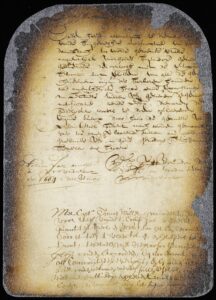
“Contract with Thomas Willett for a quantity of beef and pork, payable in slaves,” May 31, 1664, NY State Archives
According to Plymouth Colony records, Willett had an enslaved man named Jethro:
In reference unto a negro named Jethro, taken prisoner by the Indians, retaken againe by our army, which said negro appertained to the estate of the successors of Cap’s Willett, deceased, our Generall Court haue agreed with M’ John Saffin, adminnestrator of the said estate, mutually, that the said negro doe forthwith betake himselfe to his former seruice, and to remaine a servant vnto the successors of the said Captaine Willett, vntill two yeers be expired from the date heerof, and then to be freed and sett att libertie from his said seruice, prouided, alsoe, that during the said tearme of two yeers, they doe find him meat, drinke, and apparrell fitting for one in his degree and calling, and att the end of his said seruice, that hee goe forth competently prouided for in reference to apparrell.[13]
It is possible that Willett invested in slave ships but the evidence is inconclusive.
- The New Netherlands Institute database of voyages has two ships Willett invested in but neither is a slave ship. The Nieu Neerlantsche Fortuyn (later Vaerwel) arrived in 1651 and the Hoop “was a Spanish prize captured by French privateer Augustin Beaulieu with his ship Piere, and brought to New Netherland; Outfitted as merchant ship by English merchant Thomas Willet.”[14]
- On May 31, 1647, Willet served as security for the sale of the ship T’amandare (Amandare or Amandere) to Isaac Allerton of Plymouth Colony and then it sailed to Boston. The ship brought enslaved people from Brazil to New Netherland on May 8, 1646.[15] It is unclear if it sailed with enslaved people to Boston.[16] From the bill of sale: “the Amandare who, with the help of God, shall assist in conveying the ship, which must depart in eight days from date, to Boston…For greater security and the performance of this contract Mr. Isaack Allerton, inhabitant here, and Mr. Tomas Willit, residing at New Plymouth in New England…”[17] In 1650 the Amandare sailed to Brazil and landed in Virginia with thirty enslaved people.[18] The ownership of the ship at that time is unclear.
[1] Bound by Bondage, Kindle, p.46
[2] New Amsterdam Center, Petition of Thomas Willett, link
[3] New Amsterdam Center, Appointment of Isaac Grevenraet to be schout at Esopus, arrests for sedition, confiscation of furs belonging to Thomas Willett, link
[4] Bound by Bondage, Kindle, p.45-46
[5] Bound by Bondage, Kindle, p.209 n.42, NY State Archives, link
[6] New Netherland Connections: Intimate Networks and Atlantic Ties in Seventeenth-Century America, Susanah Shaw Romney, 2014, Kindle, Ch.4
[7] Bound by Bondage: Slavery and the Creation of a Northern Gentry, New York State Archives, Letter from director Stuyvesant to the vice-director of Curaçao
[8] Documents Illustrative of the Slave Trade, Donnan, ed., Vol. III, p.428; “To experiment with a parcel of negros,” p.64
[9] Northeast Slavery Records Index; original document from NY State Archives. New Netherland. Council. Dutch colonial council minutes, 1638-1665. Series A1809. Volume 10
[10] Bound by Bondage, p.6; New York State Archives. New Netherland. Council. Dutch colonial council minutes, 1638-1665. Series A1809. Volume 9.; “To experiment with a parcel of negros,” p.54, 67; Voyages of the slavers… p.225-226
[11] Plymouth Colony Archive Project, Willett
[13] Records of the colony of New Plymouth, in New England, Court Orders, November 1, 1676, p.216
[14] New Netherlands database, search by owner or charterer
[15] New Netherlands database, Voyage 108
[16]Bound by Bondage, p.210 n.48; Intra-American Slave Voyage Database, Voyage # 107713; The iconography of Manhattan Island, 1498-1909…, Volume 4, pp.111, link; “CAPTAIN THOMAS WILLETT First Mayor of New York,” Elizur Yale Smith, New York History, Vol. 21, No. 4 (October 1940), pp. 411-12, https://www.jstor.org/stable/2313473
[18] Intra-American Slave Voyages Database, #107985
Copyright 2025 Paul Hortenstine

This entry is licensed under a Creative Commons Attribution-NonCommercial-NoDerivatives 4.0 International license.

