
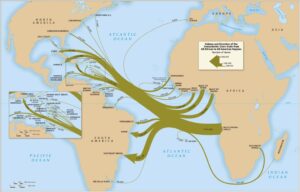
Volume and direction of the trans-Atlantic slave trade from all African to all American regions, Slavevoyages.org
Many of the mayors were from leading families who built immense fortunes from commercial ventures, including the slave trade. Twelve mayors are documented investors in thirty-four ships that carried the enslaved on fifty-eight voyages. The documented number of captives purchased in Africa is 1,193, including fifty who were taken by pirates. Of the 1,143 who were transported to colonies, 960 survived the Middle Passage. At least two hundred and eighty enslaved people were transported between colonies on ships that mayors invested in, mainly from the Caribbean to New York.
In 1627, the Dutch West India Company imported the first enslaved Africans—twenty-two people—to New Amsterdam.[1] By the late 1630s, there were about one hundred enslaved men and women in New Amsterdam, amounting to one-third of the population. Other northern colonies had enslaved people too but there were more in New Amsterdam. The ship Bruynvisch brought the twenty-two enslaved people, who were on a Portuguese ship that was captured by privateers.[2] In the summer of 1655, the Witte Paert (White Horse), which was financed by private investors, arrived in New Amsterdam with three hundred and ninety-one enslaved captives. Four hundred fifty-five captives had been purchased at Loango, in West Central Africa. It was the first slave ship to sail directly to New Amsterdam from Africa.[3] At this time, the company began taking captives from Africa to Curaçao, with some then transported to New Amsterdam.[4] The final slave ship of New Amsterdam, Gideon, also transported captives from Loango.
After the English conquest, New York merchants engaged in the slave trade by taking captives from Africa to other colonies, usually in the Caribbean. The first recorded mayor to invest in the slave trade was Cornelius Steenwyck, who owned the Leonora. In December 1666, it sailed from Textel in the Netherlands to purchase three hundred thirty-eight captives at Ardra, on the coast of the Bight of Benin. Two hundred ninety-one survived and were sold in Curaçao and Martinique.[5] Nicholas Bayard and Steenwyck invested in a slave ship the following year, Leonora and Leeuwinne. It sailed from Textel to Ardra, purchased one hundred forty-seven captives there, and the one hundred twenty-six survivors were sold in Curaçao.[6]
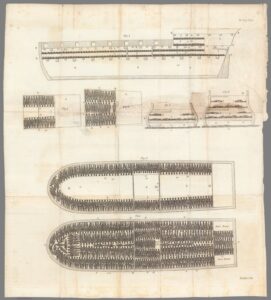
Drawing of the slave ship Brookes, 1808, Thomas Clarkson
In the 1680’s and 1690’s, New York merchants bought enslaved people in Madagascar to avoid the Royal African Company’s monopoly on captives bought from West Africa. It was chartered in 1672 but lost it monopoly on slave trade under the Trade with Africa Act of 1697 that opened Africa to merchants when it went into effect in June 1698.[7] The East India Company had rights to trade within the Indian Ocean and struggled to stop piracy there, especially in the slave trade. Frederick Philipse became the richest man in New York City through piracy: the illegal slave trade with Madagascar. Captives cost three to four pounds from Africa but could be purchased for ten shillings worth of goods on Madagascar.[8]
Mayors Stephanus Van Cortlandt, John Cruger, and Caleb Heathcote invested in separate ships that took enslaved people from Madagascar. In July 1698, Cruger was an investor in and the supercargo—crew member responsible for cargo—of the ship Prophet Daniel that accidentally landed at Matatana, a European settlement on the south coast of Madagascar, where Cruger purchased fifty enslaved people. The ship then sailed to a nearby colony where it was seized by pirates.[9] Cruger returned to Barbados on a different ship, the Vine, and then New York on the ship Blossom. Cruger’s payment to sail to Barbados included two enslaved persons. He arrived home in May of 1700. The fifty enslaved people on the Prophet Daniel were later sold in Barbados.[10] Cruger wrote an account of the voyage.
In 1713, the Treaty of Utrecht awarded Britain the exclusive right (“asiento de negroes”) to supply enslaved people to Spanish colonies in America for thirty years and effective control of the West Coast of Africa from Spain.[11] This led to large numbers of captives taken from Africa to the Caribbean and American colonies, including New York. Port records reveal that 1717 is the year with the highest number of the enslaved imported into New York directly from Africa (266) and the following year 517 enslaved persons total were imported, the most recorded.[12]
Over the next four decades, eight mayors invested in the slave trade: Abraham De Peyster, Robert Lurting, David Provoost, Paul Richard, Stephen Bayard, Edward Holland, John Cruger, and John Cruger, Jr. Their ships almost exclusively followed the same routes to and from the Caribbean. For example, David Provoost invested in the Expedition, which made five round trip voyages to Barbados in 1720 and 1721. The ship departed with provisions and lumber and returned with a total of thirty-nine enslaved persons to New York and had rum and sugar among its cargo.[13]
After the 1741, the importation of enslaved people into New York significantly decreased. From the 1750’s through the 1770’s, ships from New York sailed to Africa to purchase captives and sell them in the Caribbean, with some returning with enslaved persons to sell in New York City.[14] In the final voyage of a documented mayoral investment in the slave trade was in 1761: John Cruger, Jr. owned the Pitt, which sailed from New York and purchased eighty-seven captives in Africa. The seventy-two survivors of the Middle Passage were sold in Kingston, Jamaica the following year.[15]
The end of the slave trade came in 1788 for New York State. However, this did not end sales within the state and the illegal slave trade continued.[16] Until the Civil War, slave ships were allowed to anchor and restock in New York ports. In August 1856, Walt Whitman wrote “it is safe to say that two or three slavers per month have fitted out and sailed from New York for at least the last ten years.”[17]
From 1630 to 1766, documented slave ships brought over 12,875 of the enslaved to the port of New York (or New Amsterdam) on 756 voyages. From 1654 to 1755, trans-Atlantic slave ships brought at least 8,802 captives on eighty voyages to New York. This includes ships that stopped in New York as their second port of call. From 1630 to 1766, ships from the Caribbean to New York brought at least 4,073 enslaved people on 676 voyages.[18]
| Mayor | Ship | Dates of Voyage or in NY Port | Ports of Call | Enslaved Purchased | Cargo | Co-Investors | Citation |
| Cornelius Steenwyck | Leonora | 1666-1667 | Textel, Ardra, Curaçao, Martinique | 338, 291 survived | Jacob Dircksz Wilree | Slave Voyages website, #44270 | |
| Cornelius Steenwyck and Nicholas Bayard | Leonora and Leeuwinne | 1668-69 | Textel, Ardra, Curaçao | 147, 126 survived | Balthazar Stuyvesant (Peter’s son and governor of Curaçao in 1643–47) | #11781; Bound by Bondage | |
| Cornelius Steenwyck | Vergulde Posthoorn | 1668-69 | Textel, Ardra, Curaçao, Martinique, St. Kitts | 548, 471 survived | Gerard Hamel, Gillis van Koornbeek, and J B Reusselaer | #44281; Bound by Bondage | |
| Stephanus Van Cortlandt | Margriet | 1690 | To Madagascar, Barbados, and Virginia. | unknown | Outward: rice; Return: sugar and tobacco | Robert Livingston | Robert Livingston and the Politics of Colonial New York, p.90, n.35; Traders and Gentlefolk, p.39 |
| John Cruger | Prophet Daniel | 7/15/1698 | To Magagascar, lost to pirates | 50, seized by pirates | Outward: 150 small arms, six barrels of lead, lead, twelve casks of rum, barrels of brandy, lime juice, haberdashery, thirty-three hats, and other cargo | John Abeel, Joseph Bueno, and Van Sweeten | Pirates, Merchants, Settlers, and Slaves, p.52: UK Public Record Office, CO 5/1042, 98, pp.244 |
| Caleb Heathcote | Nassau | 7/7/1698 | To Madagascar; offloaded at Cape May and Red Hook | 23 | 70 pirates, muslin, opium, calicoes, opium, ivory, 12,000 pieces of eight, 3,000 [Dutch] “lyon dollars,” other cargo | Stephen Delancey | Pirates, Merchants, Settlers, and Slaves, p.52; “The Madagascar Connection: Parliament and Piracy, 1690-1701;” CO 5/1042, 98, 243 |
| Abraham De Peyster | John and Anne | 8/5/1717 | Nevis | unknown | Sugar, molasses, coconuts | Two sons of other mayors: Judge Samuel Bayard and Gerrardus Beekman | #107291; Donnan p.464; CO 5/1222_03, 119 |
| John and Anne | 5/14/1718 | Curaçao | 2 | Chocolate, coconuts, skins, other cargo | Judge Samuel Bayard, Rip Van Dam, and John Read | #107333; p.466; CO 5/1222, 159 | |
| John and Anne | 8/26/1718 | Barbados | 11 | Rum | Judge Samuel Bayard, Rip Van Dam, and John Read | #107357; p.468; 5/1222_04, 174 | |
| Abraham De Peyster | New York Pink | 11/18/1720 | To Maryland | 1 | 13 casks rum, nine casks sugar, 19 casks molasses, lime juice, chocolate, and provisions | Andrew Freneau, Thomas Bauyeaux, and Garrett Vanhorne | #107401;CO 5/1222_005, 242 |
| Robert Lurting | Sarah | 7/26 & 9/1/1718 | Jamaica and to Madeira | 8 total, 2 to Madeira | European goods; outward: provisions, lumber, beeswax | Thomas Lynch, Rip Van Dam, and John Bassett | #107347; p.467; CO 5/1222_04, 172, 179 |
| Pinetree | 8/13/1718 | Barbados | 1 | Ballast | Lancaster Lymes and Michael Kerney | #107352; p.468; CO 5/1222_04, 173 | |
| Pinetree | 11/28/1718 | To Madeira | 7 | Provisions, beeswax, staves, European goods | Lancaster Lymes and Michael Kerney | #107352; CO 5/1222_04, 183 | |
| George | 5/9/1721 | Jamaica | 2 | Sugar, two bags cotton wool, pewter, copper, snuff | None | #107414; p.472; CO 5/1222_06, 255 | |
| Seaflower | 10/4/1722 | Antigua | 1 | Rum, sugar, molasses, cotton wool, snuff | Thomas Lurting (likely his son), Rip Van Dam, and William Donbar | #107457; p.474; CO 5/1223_01, 17 | |
| David Provoost | Mary | 6/18/1719 | Barbados | 6 | Rum | Abraham Van Horne (his brother-in-law) | #107376; p.469; CO 5/1222_05, 208 |
| David Provoost | Expedition | 4/4/1720 | Barbados | 5 | 138 casks rum, lime juice, four casks iron, European goods | Col. William Provost (his brother) and Abraham Van Horne (their brother-in law) | #107383; p.470; CO 5/1222_05, 221 |
| Expedition | 8/8/1720 | Barbados | 5 | Rum, sugar, molasses, iron, European goods | Col. William Provost (his brother) and Abraham Van Horne (their brother-in law) | #107398; p.471; CO 5/1222_05, 228 | |
| Expedition | 4/18/1721 | Barbados | 5 | European goods, rum, sugar, soap, iron | Col. William Provost (his brother) and Abraham Van Horne (their brother-in law) | #107410; p.472; CO 5/1222_06, 254 | |
| Expedition | 7/31/1721 | Barbados | 15 | Rum | Col. William Provost (his brother) and Abraham Van Horne (their brother-in law) | #107436; CO 5/1222_06, 259 | |
| Expedition | 10/21/1721 | Barbados | 9 | None listed | Col. William Provost (his brother) and Abraham Van Horne (their brother-in law) | #107440; p.473; CO 5/1222_06, 262 | |
| Expedition | 6/22/1723 | Barbados | 5 | Sugar, three bags cotton wool, five bags of coconuts, one horse | Col. William Provost (his brother) and Abraham Van Horne (their brother-in law) | #107464; p.474; CO 5/1223_02, 33 | |
| Paul Richard | Anne and Catherine | 8/6/1723 | Curaçao | 6 | 60 casks coconuts, three casks of old iron | Philip French III (son of mayor), and Matthew Clarkson | #107467; p.475; CO 5/1223_02, 35 |
| Paul Richard | Dolphin | 6/14/1725 | Curaçao | 3 | Lime juice, coconuts, iron | Philip French III (son of mayor), and Matthew Clarkson | #107511; p.478; CO 5/1223, 89 |
| Stephen Bayard | Allida | 11/30/1724 | St. Thomas | 1 | 104 casks sugar, 49 bags cotton wool, five casks coconuts, soap | Abraham De Peyster, Jr. (son of mayor), Frederick Van Cortlandt (son of mayor Jacobus), John Brown, and Rip Van Dam | #107501; p.477; CO 5/1223_003, 77 |
| Ranger | 5/18/1727 | Antigua | 2 | 76 casks rum, 26 casks brown sugar, molasses, two pipes Madeira wine | Peter Bayard, Henry Cuyler, and Joseph Royall | #107573; p.482; CO 5/1224 Part 1, 60 | |
| Black Eyed Susan | 9/3/1728 | Curaçao | 1 | 32 casks & 22 bags coconuts, two bags cotton wool, fourteen casks pimento, one cask old iron | His brothers Nicholas and Samuel, Jr. Bayard, and Rip Van Dam | #107614; p.484; Jordaan, Han,”The Curaçao Slave Market: From Asiento Trade to Free Trade;” CO 5/1224 Part 2, 125 | |
| Byam | 9/28/1730 | Antigua | 2 | Rum, sugar, molasses | Michael Thodey, Nathaniel Gilbert, and Philip Livingston | #107711; p.491; CO 5/1224, 226 | |
| Byam | 4/21/1731 | Antigua | 4 | Three casks rum, at least 29 casks molasses, sugar | Michael Thodey, Nathaniel Gilbert, and Philip Livingston | #107716; p.491; CO 5/1225_001, 2 | |
| Paul Richard | Prince William | 11/20/1728 | To Jamaica | 2 | 57 tons provisions, three casks linseed oil, staves, European goods | Moses Levy, Robert Livingston, Daniel Clarkson, and Matthew Clarkson | #107626, p.485; CO 5/1224 Part 2, 135 |
| Prince William | 1/20/1729 | Jamaica | 1 | Thirteen casks pimento, ten casks lime juice, three casks & one hamp. rum, one cask iron, sugar, six casks indigo | Moses Levy, Robert Livingston, Daniel Clarkson, and Matthew Clarkson | #107627; CO 5/1224, Part 2,, 139 | |
| Prince William | 8/25/1729 | Jamaica | 2 | One cask rum, bottles, two casks old pewter, copper, 150 casks molasses, two casks sugar | Moses Levy, Robert Livingston, Daniel Clarkson, and Matthew Clarkson | #107661; p.487; CO 5/1224 Part 2, 165 | |
| Stephen Bayard | Francis | 2/5/1730 | Antigua | 9 | One cask rum, European goods, four casks cotton wool, 32 casks molasses | William Smith, Nathaniel Gilbert, and Philip Livingston | #107675; p.488; CO 5/1224 Part 2, 196 |
| Francis | 6/26/1730 | Antigua | 16 | Rum, sugar, European goods | William Smith, Nathaniel Gilbert, and Philip Livingston | #107693; p.490; CO 5/1224, 221 | |
| Francis | 4/26/1731 | Antigua | 6 | 92 casks rum, five casks apothecary wares, sugar, molasses | William Smith, Nathaniel Gilbert, and Philip Livingston | #107717; p.491; CO 5/1225 Part 1, 2 | |
| Francis | 9/15/1731 | Antigua | 24 | 34 casks rum, sugar | William Smith, Nathaniel Gilbert, and Philip Livingston | #107736; p.492; CO 5/1225, Part 1, 11 | |
| Stephen Bayard | Turtle Dove | 6/8/1738 | Jamaica | 10 | Sugar, molasses | Nathaniel Marston and James Searle | #107865; p.502; CO 5/1226, 5 |
| Stephen Bayard | Antigua Packet | 11/15/1739 | Antigua | 2 | Rum, 50 barrels sugar | His brother Nicholas Bayard, Henry Lawrence, Abraham Lynsom, William Turnell and Nathaniel Marston | #107900; p.505; CO 5/1226, 69 |
| Antigua Packet | 6/16/1740 (Perth Amboy then NY) | Antigua | 24: 20 at Perth Amboy, 4 at NY | 76 bags ginger, one packet cotton wool | His brother Nicholas Bayard, Henry Lawrence, Abraham Lynsom, William Turnell and Nathaniel Marston | #107151; p.505, 512: NJ; CO 5/1226, 95; CO 5/1035_03, 72 (Perth Amboy) | |
| Antigua Packet | 11/18/1740 | Antigua | 2 | Rum, sugar, molasses, duck | His brother Nicholas Bayard, Henry Lawrence, Abraham Lynsom, William Turnell and Nathaniel Marston | #107921; p.506; CO 5/1226, 126 | |
| Antigua Packet | 7/26/1742 | Antigua | 4 | 33 casks sugar, six casks rum, European prize goods | His brother Nicholas Bayard, Henry Lawrence, Abraham Lynsom, William Turnell and Nathaniel Marston | #107946; p.508; CO 5/1226, 220 | |
| Paul Richard | Hestser | 5/15/1735 | St. Thomas | 1 | 72 bales cotton, three casks sugar, salt | Mordecai Gomez and David Gomez | #107820; p.498; CO 5/1225 Part 2, 159 |
| Hester | 8/28/1735 | St. Thomas | 2 | 59 bags cotton wool, fifteen tons fustick, hats, sugar, and other cargo | Mordecai Gomez and David Gomez | #107828; p.499; CO 5/1225 Part 2, 165 | |
| Hester | 8/29/1737 | St. Thomas | 1 | Cotton wool, salt | Mordecai Gomez and David Gomez | #107851; p.501; CO 5/1225, Part 2, 206 | |
| Hester | 8/31/1739 | St. Thomas | 3 | Cotton wool | Mordecai Gomez and David Gomez | #107894; p.504; CO 5/1226, 56 | |
| Hester | 9/1/1740 | St. Thomas, Spanish Town Virgin Islands | 1 | Fourteen bags cotton wool, 26 bags British cotton wool | Mordecai Gomez and David Gomez | #107916; p.506; CO 5/1226, 109 | |
| Edward Holland | Thomas | 9/23/1732 | Barbados | 3 | Rum, at least eighteen barrels sugar | John Stevens, John Groesbeak, Thomas Bayeaux, and David Minville | #107763; p.494; CO 5/1225_001, 49 |
| John Cruger | Union | 5/31/1737 | Antigua | 2 | 20 casks rum | Nathaniel Marston Jr., Thomas Marston, Abraham Lansing, and Henry Lawrence | #107841; p.500; CO 5/1225, 200 |
| Paul Richard | Prince Frederick | 11/2/1739 | Jamaica | 4 | Pimento, two casks rum, sugar, ginger, seven and a half tons logwood, four casks lime juice | Moses Levy, Robert Livingston, Daniel Clarkson, and Matthew Clarkson | #107899; p.505; CO 5/1226, 69 |
| Paul Richard | Elisabeth (schooner) | 9/17/1728 | Jamaica | 2 | Sixty-two casks of molasses and one cask of sugar | His brother John Richard | #107617; CO 5/1224, Part 2, 127 |
| Elisabeth | 9/17/1730 | Suriname | 2 | 36 casks rum, 1 cask sugar, 72 casks molasses, three casks coffee berries | His brother John Richard | #107681; p.489; CO 5/1224, Part 2, 208 | |
| Paul Richard | Elisabeth (sloop) | 6/13/1739 | St. Thomas, Spanish Town Virgin Islands | 5 | Straw ware, furniture, planks | Mordecai Gomez and David Gomez | #107889; p.504; CO 5/1226, 44; CO 5/1227, 7: fixes error in 5/1226 |
| Elisabeth | 5/28/1740 | St. Thomas, Virgin Islands | 1 | 28 bags British cotton wool, 35 bags pimento, two tons logwood, 47 bags cotton wool | Mordecai Gomez and David Gomez | #107909; p.505; CO 5/1226, 94 | |
| Elisabeth | 9/30/1742 | St. Thomas, Jamaica, Spanish Town Virgin Islands | 3 | Sugar, cotton wool or cotton, molasses | Mordecai Gomez and David Gomez | #107947; p.508; CO 5/1226, 225 | |
| John Cruger, Jr. | Legunea | 6/9/1740 | Jamaica and Curaçao | 10 | Ten casks coconuts, one cask coffee, one cask pimiento, one bag snuff, one cask lime juice, one box indigo, one box silk | His brother Henry Cruger, Jacob Phoenix, and Henry Cuyler | #107910; p.505; CO 5/1226, 94 |
| John Cruger, Jr. | Mary | 4/20/1743 | St. Kitts | 2 | Five casks sugar, 40 casks rum, molasses | His brother Henry Cruger | #107949; p.508; CO 5/1226, 235 |
| John Cruger, Jr. | Virgin | 5/30/1751 (Perth Amboy) | St. Kitts | 34 | Rum | His brother Henry Cruger and John Watts | #107157; p.512; CO 5/1035, part 5, p.165 and part 6, p.197 |
| John Cruger, Jr. | Pitt | 1761-1762 | New York, Africa, Jamaica | 87, 72 survived | None listed but possible there were other investors | #24543; CO 142/16, p.144-5,164-5 |
Next: Terms of Enslaver Mayors
________________________________________________________________________________________________________________
[1] In the Shadow of Slavery, Kindle edition, p.13
[2] New Netherland Institute, Resources Worksheet and Timeline, link
[3] Slave Voyages Database, voyage #11295; New Netherland Institute voyage 170, link; “Tale of the White Horse” by Dennis J. Maika, link
[4] Black Cargoes: A history of the Atlantic Slave Trade, 1518-1865, p.62-63, link
[5] Slave Voyages Database, Trans-Atlantic, Voyage #44270
[6] Slave Voyages Database, Trans-Atlantic, Voyage #11781
[7] “The East India Company and the Madagascar Slave Trade,” Virginia Bever Platt, The William and Mary Quarterly, Vol. 26, No. 4, Oct. 1969; “New York and the Slave Trade, 1700 to 1774,” James G. Lydon, The William and Mary Quarterly, Vol. 35, No. 2 (Apr., 1978), pp.376; Black Cargoes, p.64
[8] The New York African Burial Ground: Unearthing the African Presence in colonial New York, Vol. III, GSA, report
[9] New York Wills and Administrations, Vol 017, 0019-0021, 1749-1760, Will 31 Jan 1753, Probate 1 Mar 1757, Ancestry.com, digital p.500-01
[10] The Memorial History of the City of New York, p.285-286; Trans-Atlantic Slave Database, Voyage ID #37014
[11] Black Cargoes, p.67-68; “‘To experiment with a parcel of negroes,'” p.47-50
[12] U.S. Census, Colonial Statistics, Slave Trade in New York: 1701 to 1764, digital p.22, link
[13] Slave Ship Voyages Database, Intra-American, Voyages #107383, 107398, 107410, 107436, and 107440
[14] “New York and the Slave Trade, 1700 to 1774,” James G. Lydon, The William and Mary Quarterly, Vol. 35, No. 2 (Apr. 1978), pp. 375-394
[15] Slave Voyages Database, Trans-Atlantic, #24543
[16] “Slavery in New York,” Ira Berlin and Leslie M. Harris editors, 2005, online edition, p.4, 47, 60, 64, 126, and 127; New York Historical Society, Slavery in New York, Fact Sheet
[17] Whitman, Walt. “The Slave Trade.” The Walt Whitman Archive. Gen. ed. Matt Cohen, Ed Folsom, & Kenneth M. Price, link
[18] Data from SlaveVoyages.org, including slave ships with New York as second port of call
Copyright 2025 Paul Hortenstine

This entry is licensed under a Creative Commons Attribution-NonCommercial-NoDerivatives 4.0 International license.

