Category: NYC Mayors

Philip French: 28th

Philip French, Mayor 1702-1703: French (1666/7 – c.1707) was a merchant who engaged in piracy through Madagascar and invested in large real estate tracts in New York and New Jersey. He married Anna Philipse, daughter of perhaps the richest man in the colony, Frederick Philipse.[1] Through a partnership with Philipse, it is likely that French was involved in the slave trade in Madagascar, but there is no documentation of investments in slave ships.[2] On August 11, 1695, French, Robert Livingston, Captain William Kidd, and Captain Giles Shelley met in London to discuss replacing Governor Benjamin Fletcher with Lord Bellomont. Their discussion likely included Madagascar and Indian Ocean piracy.[3]

He is listed as an enslaver in the New York census from c.1703: seven enslaved people, including three adult males, two adult females, one minor male, and one minor female.[4]A transcript of colonial documents states that French owned an enslaved Indian in 1689:

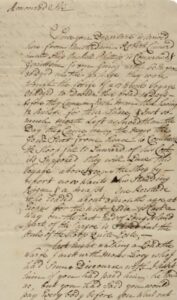
The same Night an Indian Slave belonging to Philip French was dragged to the Fort and there Imprisoned. The next day Mr French falling in amongst some of Leyslers crew, resented the injury done unto him by the illegal detaining of his Slave so highly that some of the standers-by immediately went and informed against him so that in a short time after as the said French was walking in the publick streets of this City about his lawful affairs, John Burger Serjeant to this Usurper Leysler attended with six Musqueteers, lays violent hands on him and tells him, he was his Prisoner and to the Fort he must go. Mr French replyed, not unless you carry me, which accordingly they did, in the nature of a dead Corpse, though living, where he soon meets with the Entertainment of a close imprisonment.[5]

[1] “Frederick Philipse and the Madagascar Trade,” Jacob Judd, The New-York Historical Society Quarterly, Vol. 55, No. 4, October 1971, link

[2] Merchants and Empire, 63, 86, 207, 354 n.64, 373 n.28, 398.80

[3] “Robert Livingston’s Voyage to England, 1695,” Lawrence Leder, New York History, Vol. 36, No. 1, pp.30, https://www.jstor.org/stable/23154363

[4] Northeast Slavery Records Index, Dock Ward; French Family Assoc. history; Conway: Lists of Inhabitants of Colonial New York, p. 32

[5] Documents relative to the Colonial History of New York, Vol. III, p.678

Copyright 2025 Paul Hortenstine

William Peartree: 29th

William Peartree, Mayor 1703-1707: Peartree (c. 1643 – 1714) began his career in Jamaica and lived in Port Royal. He owned land there, but it is unclear if it was a plantation. He was a merchant who had extensive dealings with Jacobus Van Cortlandt and engaged in piracy.[1]

In the New York census of c.1703, Col. William Peartree is listed as having six enslaved people in his household in New York City: two adult males, two adult females, one minor male, and one minor female.[2]

In his will, Peartree describes his property in Jamaica in the usual language of wills of the time as “houses, lands, tenements…buildings” and gives it to his wife, Anna. In his will, he also gives his wife “…all my household goods and furniture whatsoever and all my wrought plats [sic] and all my negro slaves.” He also left property to his grandson, William Smith.[3]

[1] Conquest and Change, Ch.3, Kindle edition location 934

[2] NYG&B Record, January 1879: Volume 10, issue 1, p.32

[3] Northeast Slavery Records Index; Conway, Rosanne: Lists of Inhabitants of Colonial New York, p. 31; New York, U.S., Wills and Probate Records, 1659-1999, Wills, Vol 008, 1710-1716, Will Date 20 Jan 1713, Probate Date 29 Apr 1714, Ancestry.com, link

Copyright 2025 Paul Hortenstine

Ebenezer Wilson: 30th

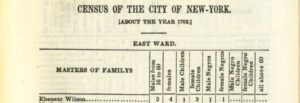
Ebenezer Wilson, Mayor 1707-1710: Wilson (c.1650-?) was a merchant who traded agricultural products with the West Indies.[1] In the New York census of c.1703, Wilson is listed as having two enslaved people in his household in New York City: one adult male and one adult female.[2]

1703 Census of the City of New-York, The Documentary History of the State of New-York, 1849

In September 1717, there is a petition from a free man to Governor Robert Hunter stating that Wilson detained an enslaved man. From a summary:

Sept. 5. Petition. Sam, late negro slave of George Norton, deceased, complaining that Ebenezer Wilson detains money and a negro willed to him by said Norton, yet requires the petitioner to clothe said slave and support him in sickness.[3]

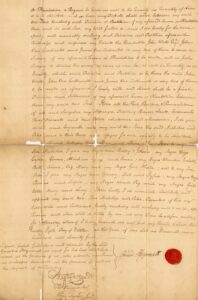
In George Norton’s will of May 1, 1715, he names Capt. Ebenezer Wilson the sole executor and trustee of his will. Norton gives Sam his freedom and wills him another enslaved man, Robin, and thirty pounds.[4] Wilson kept Robin and the money. In September 1717, Sam petitioned the governor because Wilson “detains money and a negro willed to him by said Norton, yet requires the petitioner to clothe said slave and support him in sickness.”[5]

[1] Merchants & Empire, p.222

[2] Northeast Slavery Records Index; Conway, Rosanne: Lists of Inhabitants of Colonial New York, p.22, East Ward

[3] Calendar of historical manuscripts in the office of the secretary of state, Albany, N.Y., New York Secretary of State, E.B. O’Callaghan, Vol. II, p.433

[4] New York, U.S., Wills and Probate Records, 1659-1999, George Norton, Will Date 1 May 1715, Wills, Vol 008, 1710-1716, Ancestry.com

[5] Calendar of historical manuscripts in the office of the secretary of state, Albany, N.Y., New York Secretary of State, E.B. O’Callaghan, Vol. II, p.433; New York, U.S., Wills and Probate Records, 1659-1999, George Norton, Will Date 1 May 1715, Wills, Vol 008, 1710-1716, Ancestry.com

Copyright 2025 Paul Hortenstine

Robert Walters: 35th

Robert Walters, Mayor 1720-1725: Walters (c.1660-1733) was a wealthy merchant and ended his career as a judge. He was an enslaver and his will lists an estate in Jamaica. He is described as Captain Robert Walters in tax assessment rolls of July 1699 in the East Ward.[1]

According to a history of New York published in 1877: Robert Walters “was one of the wealthy men of the period, liberal and public-spirited. He lived in style, kept several horses, owned a large number of negro slaves, and his family always dressed in the latest fashion; but they never entertained guests except their own immediate relatives.”[2]

His wife, Katherine, was the daughter of Jacob Leisler. Leisler was a very successful New York City merchant and slave ship investor who worked as an official of the Dutch West India company when he arrived in the colony in 1660. His operation included supplying the Delaware Valley with finished cloth and trade goods, enslaved people and indentured servants, and alcohol in exchange for tobacco and grain. However, Leisler led an insurrection in 1689 in support of the Glorious Revolution by less prominent Dutch settlers and acted as governor until 1691. When England retook the colony, it executed Leisler.[3] In his will, Walter leaves his wife real estate, including “lands and tenements on the island of Jamaica, left to me by my brother John Walter.”[4] It is unclear which land or plantation this is.[5]

In 1691, there is a petition by Robert Walters to the governor “for the delivery to him of a negro sent him by Sir Francis Watson, knight, of Jamaica, to dispose of, and detained on board the man of war Arch Angel.”[6]

In September 1711, there is a petition to Governor Robert Hunter from “Sarah Robins, a free Indian woman, and native of the province of New York, about her freedom; she lived at Southampton; finally came into the possession of Robert Walters, who sold her as a slave and sent her to Madeira, whence she was returned by the English consul to New York [this is a summary].”[7] It is unclear which ship she sailed on and how Governor Hunter disposed of her case.

To his Excellency Robert Hunter Esq. Captain General and Governor in chiefe in and over Her Majestys Province of New York and New Jerseys and of all the Territorys and Tracts of Land Depending thereon in America and Vice Admiral of the Same The humble Petition of Sarah Robins a Free born Indian Woman Sheweth Unto your Excellency that your Petitioner is a Native of this Her Majestys Province and was born of free parents[,] hath lived great part of her time upon Long Island with one John Parker of Southampton[,] and by him was turned over to One John Week of Bridgehampton on the said Island who turned her over to Captain Robert Walters of the City of New York[,] but on what Account she knoweth not[.] The said Robert Walters upon the first day of January last caused your Petition[er] against her will to be Transported unto the Island of Madeira in Order to be there sold for a slave [. B]ut after her arrival in the said place upon her application to the English Consul and declaring that she was a Free subject[,] the said Consul so procured that Captain Peter Roland[,] who brought her into the said Island[,] should bring her back again to this Colony[,] she having before refused to be made a free woman if she would have turned to the Roman Catholik [sic] faith and be therein baptized[.] And your Petitioner being still in fear that she may be further Imposed on and at some time or other Craftily conveyed to some other part of the World under the Notion of a slave[,] she Doth therefore in most humble manner pray that the said John Parker[,] John Week[,] or the said Robert Walters may be put to prove their Title to her as a slave[. A]nd if they fail therein Then she humbly prays your Excellencys Protection whereby she may be suffered to live quietly and safely in this her Native Country as a Free born subject of the same[.] And she as in Duty bound shall ever pray[.]

In a 1698 census, John Parker is in Southampton. The census includes male Indians over 15 but “the Squas and children few of whom have any nam[e].” She does not appear in census records for New York City either.[8] Southold town records have a notice of a sale from James Parshall to John Parker of Sarah on March 27, 1698. However, this appears to be recorded on May 10, 1712.

Know all men by these presents that I James Paresall [Parshall] belonging to Southold in y County of Suf- folk on y Island of Nassaw yeoman have sold & de- livered unto John Parker of Southampton fuller an Indian Garle aged about eight years daughter of one Dorkas an Indian woman, which said Sarah was my slave for her life time; and I doe by these presents sell her ye sª Sarah unto him the said John Parker dureing her naturall life, to be unto him ye said Parker his heires & assignes as his or their proper estate; and I doe bind myself my heirs, executs and administrats to make good y sale of y abovesaid Indian gairle to him ye said Parker his heirs & assignes; and I doe ac- knowledge to have received of him ye said Parker for and in consideration of said Indian garle as full satis- faction, the full & just sum of sixteen pounds current money of this province. In Witness whereof I have hereunto sett my hand and seale this 27th day of March 1698. his JAMES I PEARSALL [Parshall]. Witnesses. JOSEPH MOORE SAMUEL CLARKE- Entª May ye 10th 1712. mark Pr Benj: Youngs Town Clerk[9]

A 1918 history of Southampton notes the case as an example of an enslaved Indian at the time and includes the text of Sarah’s petition.[10]

[1] December 1695 to July 15th, 1699: tax lists, v.44:no.1-2, from New York Historical Society

[2] History of the city of New York: its origin, rise, and progress,  Mrs. Martha J. Lamb and Mrs. Burton Harrison … v.1, Hathi Trust, p.517

[3] “The Leisler Rebellion in the Delaware River Valley,” David William Voorhees; Listed as Robert Walter, Will Date 14 Jun, Probate Date, 12 Nov 1736; son John Walter, administrator, New York, U.S., Wills and Probate Records, 1659-1999

[4] Abstracts of wills on file in the Surrogate’s Office, City of New York, 1665-1801. V. 3, Will date June 17, 1719, Page viewer 230, FamilySearch; New York, U.S., Wills and Probate Records, 1659-1999, Wills, Vol 013, 1736-1741, Probate Date 20 Nov 1737, Ancestry.com

[5] “Planters, Merchants, and Slaves: Plantation Societies in British America, 1650-1820,” Trevor Burnard, 2015; Centre for Study of the Legacies of British Slavery, database search

[6] Calendar of historical manuscripts in the office of the secretary of state, Albany, Vol. II, E.B. O’Callaghan, p.212

[7] New York State Archives, original petition

[8] The Documentary History of the State of New-York, ed. by E.B. O’Callaghan, Vol. I, p.665 and 669; NYG&B, Pre-1750 New York lists; Calendar of historical manuscripts in the office of the secretary of state,, Vol. II, E.B. O’Callaghan, p.394

[9] Southold town records / copied and explanatory notes added by J. Wickham Case v.2, 1884, p.179

[10] History of the Town of Southampton, 1918, p.120

Copyright 2025 Paul Hortenstine

Robert Lurting: 37th

Robert Lurting, Mayor 1726-1735: Lurting (c.1653 -1735) was a merchant who invested in the slave trade and exported logwood from the Hudson region and other goods to London. He also owned large tracts of land.[1] He died while in office.

  • Lurting invested in four ships that transported enslaved people from the Caribbean to New York between 1718 to 1722. Two of the vessels, Sarah and Pinetree, also carried enslaved persons from New York to Madeira.
  • In the c.1703 census of New York, Robert Lurting is listed as owning two enslaved people in his household in New York City: one adult female and one minor male.
  • In 1721, Lurting bought Kate for twenty-seven pounds. The sale is mentioned in a court case over a later enslaver of Kate, Thomas Roberts, knowingly selling her while sick and is to blame for her death from a secret “infectious malady or sickness called the French pox.”[2]

A ship named the Salley was lost at sea and the enslaved on it either escaped or died. Trinity Church applied to have the settlement funds from the loss of the enslaved persons be applied to the building fund of Trinity Church in December 1697. Lurting was a Church Warden.[3]

Investments in Ships that Transported Enslaved

Ship Dates of Voyage or in NY Port Ports of Call Enslaved Purchased Cargo Co-Investors
Sarah 7/26 & 9/1/1718 Jamaica and to Madeira 8 total, 2 to Madeira European goods; outward: provisions, lumber, beeswax Thomas Lynch, Rip Van Dam, and John Bassett
Pinetree 8/13/1718 Barbados 1 Ballast Lancaster Lymes and Michael Kerney
Pinetree 11/28/1718 To Madeira 7 Provisions, beeswax, staves, European goods Lancaster Lymes and Michael Kerney
George 5/9/1721  Jamaica 2 Sugar, two bags cotton wool, pewter, copper, snuff None
Seaflower 10/4/1722 Antigua 1 Rum, sugar, molasses, cotton wool, snuff Thomas Lurting (likely his son), Rip Van Dam, and William Donbar

[1] Merchants & Empire, 1998, p.143

[2] Douma, Michael. “Prices of Enslaved Persons in New York and New Jersey.” Journal of Slavery and Data Preservation 4, no. 5 (2023): 67-75; taken from Select Cases of the Mayor’s Court of New York City, 1674-1784. Vol. 2. page 369

[3] Northeast Slavery Records Index, citing Ecclesiastical Records of State of NY, Volume II, p. 1217 and Conway, Rosanne: Lists of Inhabitants of Colonial New York, p. 33

Ship investments: 107347, Donnan p.467, CO 5/1222_04, 172, 179; #107352, p.468; CO 5/1222_04, 173; #107352, CO 5/1222_04, 183; #107414, p.472, CO 5/1222_06, 255; #107457, p.474, CO 5/1223_01, 17

Copyright 2025 Paul Hortenstine

Paul Richard: 38th

Paul Richard (Paulus Richards), Mayor 1735-1739: Richard (1697 -1756) owned enslaved people and was a slave trader. He also imported West Indies goods to New England ports and exported fish to southern European Catholic kingdoms.[1]

Richard invested in seven ships that transported enslaved people from the Caribbean to New York from 1723 to 1742. Many of the vessels carried one or two enslaved persons to New York along with agricultural products like coconuts, sugar, and lime juice. 

His involvement in slavery:

  • Maria and Cato, who were enslaved by Richard, were accused of conspiracy but not arrested in 1741. Maria’s husband, Quack, was an enslaved man to the butcher John Walter.[2]
  • Richard had an enslaved man named Galloway. A later enslaver, John Breese, described him as a “mullato Indian” in a runaway newspaper notice.
  • Richard also had an enslaved woman, Elizabeth.[3]

In April 1700, Richard offered a reward for finding who committed the murder of his daughter and a woman slave. From summaries of his petitions to Governor Richard Coote, Earl of Bellomont:

  • “April 8, 1700: Petition. Paul Richards, requesting that a proclamation be issued, oftering a reward for the discovery of the murderers of his daughter and servant girl, on the 19th October last.”
  • “Petition. Martinus Lamberse, for a speedy trial, a true bill having been ibund against him for the murder of Hester, wife of Marcus LeflPert, of New York (daughter of Paulus Richard), and a negro woman.”[4]

Investments in Ships that Transported the Enslaved

Ship Dates of Voyage or in NY Port Ports of Call Enslaved Purchased Cargo Co-Investors
Anne and Catherine 8/6/1723 Curaçao 6 60 casks coconuts, three casks of old iron Philip French III (son of mayor), and Matthew Clarkson
Dolphin 6/14/1725 Curaçao 3 Lime juice, coconuts, iron Philip French III (son of mayor), and Matthew Clarkson
Prince William 11/20/1728 To Jamaica 2 57 tons provisions, three casks linseed oil, staves, European goods Moses Levy, Robert Livingston, Daniel Clarkson, and Matthew Clarkson
Prince William 1/20/1729 Jamaica 1 Thirteen casks pimento, ten casks lime juice, three casks & one hamp. rum, one cask iron, sugar, six casks indigo Moses Levy, Robert Livingston, Daniel Clarkson, and Matthew Clarkson
Prince William 8/25/1729 Jamaica 2 One cask rum, bottles, two casks old pewter, copper, 150 casks molasses, two casks sugar Moses Levy, Robert Livingston, Daniel Clarkson, and Matthew Clarkson
Hestser 5/15/1735 St. Thomas 1 72 bales cotton, three casks sugar, salt Mordecai Gomez and David Gomez
Hester 8/28/1735 St. Thomas 2 59 bags cotton wool, fifteen tons fustick, hats, sugar, and other cargo Mordecai Gomez and David Gomez
Hester 8/29/1737 St. Thomas 1 Cotton wool, salt Mordecai Gomez and David Gomez
Hester 8/31/1739 St. Thomas 3 Cotton wool Mordecai Gomez and David Gomez
Hester 9/1/1740 St. Thomas, Spanish Town Virgin Islands 1 Fourteen bags cotton wool, 26 bags British cotton wool Mordecai Gomez and David Gomez
Prince Frederick 11/2/1739 Jamaica 4 Pimento, two casks rum, sugar, ginger, seven and a half tons logwood, four casks lime juice Moses Levy, Robert Livingston, Daniel Clarkson, and Matthew Clarkson
Elisabeth (schooner) 9/17/1728 Jamaica 2 Sixty-two casks of molasses and one cask of sugar His brother John Richard
Elisabeth 9/17/1730 Suriname 2 36 casks rum, 1 cask sugar, 72 casks molasses, three casks coffee berries His brother John Richard
Elisabeth (sloop) 6/13/1739 St. Thomas, Spanish Town Virgin Islands 5 Straw ware, furniture, planks Mordecai Gomez and David Gomez
Elisabeth 5/28/1740 St. Thomas, Virgin Islands 1 28 bags British cotton wool, 35 bags pimento, two tons logwood, 47 bags cotton wool Mordecai Gomez and David Gomez
Elisabeth 9/30/1742 St. Thomas, Jamaica, Spanish Town Virgin Islands 3 Sugar, cotton wool or cotton, molasses Mordecai Gomez and David Gomez

[1] Merchants & Empire, p.144

[2] Lepore database, files titled app B—owners and Persons; New York Burning…, Lepore, 2006; Page 222: “Mr. Richard’s Cato” page 159: “That the negro boy Cato, Mr. Richards…”  page 44: John Richard. Page 334: Paul Richard, esq. page 335: Paul Richard, esq.

[3] Bound by Bondage, p.247, note 19

[4] Calendar of historical manuscripts in the office of the secretary of state, E.B. O’Callaghan, Vol. II, p.274

Ship investments: #107467, Donnan p.475, CO 5/1223_02, 35; #107511, p.478, CO 5/1223, 89; 107626, p.485, CO 5/1224 Part 2, 135; #107627, CO 5/1224, Part 2,139; #107661, p.487, CO 5/1224 Part 2, 165; #107820, p.498, CO 5/1225 Part 2, 159; #107828, p.499, CO 5/1225 Part 2, 165; #107851, p.501, CO 5/1225, Part 2, 206; #107894, p.504, CO 5/1226, 56; #107916, p.506, CO 5/1226, 109; #107899, p.505, CO 5/1226, 69; #107617, CO 5/1224, Part 2, 127; #107681, p.489, CO 5/1224, Part 2, 208; #107889, p.504, CO 5/1226, 44, CO 5/1227, 7: fixes error in 5/1226; #107909, p.505, CO 5/1226, 94; #107947, p.508, CO 5/1226, 225

Copyright 2025 Paul Hortenstine

Gerardus Stuyvesant: Acting Mayor

Gerardus Stuyvesant (Peter Gerard Stuijvesant or Stuyvezandt), Acting Mayor August to October 1744: Stuyvesant (1691-1777) was the grandson of Peter Stuyvesant and owned the family property that was known as Stuyvesant’s Bowery Number One. Peter Stuyvesant’s family lived on the farm and there were about forty enslaved people there. In his will, Gerardus leaves the Stuyvesant farm to his son, Peter.

There are many overviews of the plot of land that belonged to Peter Stuyvesant and his heirs, including The New Netherland Institute, Village Preservation Blog, and The New Amsterdam History Center.

Gerardus leaves nineteen enslaved persons to his two sons in his will.

  • To his son Nicholas, he left Harry, John [?], “my negro boys” Cyrus, Gimm, Abraham, and Isaac. “My negro wenches” Isabell, Bett, Anna, big Mary, and “my negro girl Phoebe.”
  • To his son Peter, he left “my negro men Gansey, Dick, and Syphax,” “my negro boys Primus and Scipio,” “my negro wench Peg,” and “my negro girls little Mary and Lucy.”[1]

Probated will of Gerardus Stuyvesant, 1786, NY State Archives

On April 23, 1719, Gerardus Stuyvesant recorded the indenture of Peter Jacobson, “a free negro,” for six and a half years.[2]

On October 11, 1777, his son Peter posted a runaway notice for three of the enslaved men he inherited:

1777: FIFTY DOLLARS Reward. RUN-away from the subscriber, three negro fellows, viz. PRIMUS, a very likely fellow, about 22 years of age, speaks very civil and mild; went away the first of October, 1776. SYPHAX, about 34 years old, speaks broken English, very lasey and slow; went away some time in November, 1776.  SCIPIO, about 18 years old, went away on Wednesday night the 8th inst. he is a very handy fellow, stoops when he walks, and is apt to stammer when he talks quick.  [$25 for Primus, $12 each for Syphax and Scipio]  STUYVESANT, Petersfield, near New-York, Octo. 11, 1777[3]

[1] New York State Archives, Gerardus Stuyvesant, probated will, 1786

[2] Collections of the New York Historical Society for the year 1909, Family Search, page viewer 139 of 238

[3] N-Y Gazette, and W Mercury, October 20, 1777, p. 4, col. 1 Northeast Slavery Record Index, Thomson notes, p.54

The minutes of the Common Council refer to Stuyvesant as mayor from September 11 to September 29, 1744. MCC, 1675-1776, Vol.V, p.125-127. This was after the death of the previous mayor, John Cruger, in August, and before the next mayor, Stephen Bayard, was appointed. Bayard presided over the council meeting on October 14. 

Copyright 2025 Paul Hortenstine

Stephen Bayard: 40th

Mayor Stephen (Stephanus) Bayard, 1744-1747: Bayard (1700-1757) was a merchant who participated in the slave and sugar trade, and his grandfather Nicholas Bayard also served as mayor. His business partners included brothers Philip and Robert Livingston, some of New York’s most well-known slave traders.[1] Bayard’s brother Nicholas (1698-1765) opened the first sugar mill in New York City in 1730.[2]

Bayard invested in seven ships that transported enslaved people from the Caribbean to New York from 1724 to 1742. In 1740, twenty enslaved persons disembarked from the Antigua Packet at Perth Amboy and then four in New York along with cargo of ginger and cotton wool. Perth Amboy served as an important port for New Jersey’s merchants and slave trade.  

On March 12, 1724, Bayard married Alida Vetch, granddaughter of Robert Livingston and daughter of Alida Schuyler Van Rensselaer. Their marriage united the wealthy Stuyvesant, Bayard, Livingston, and Van Rensselaer families. After their marriage, they lived in a Dock Street house given to them by Robert Livingston. Alida brought an enslaved girl, Dina, as part of her dowry.[3] On August 1, 1722, Robert Livingston noted that he charged Alida’s father, Sameul Vetch, for “1 negro girl of 5 years of age called Dina,” who was given to Alida.[4]

Stephen Bayard to Robert Livingston, November 12, 1725, Gilder Lehrman Collection

Involvement with Slavery:

  • From the transcript of the 1741 trial, Bayard had an enslaved man named Ben, who was indicted but fled and could not be found.[5]
  • In his 1753 will, Bayard bequeathed to his daughter Margaret “two negro or Indian slaves one named Pashanse and the other Pegey and the children they may get to be delivered” when Margaret comes of age or is married. He left other enslaved persons to his sons William and Robert. They are listed among other possessions: “plates, furniture, negro slaves, cattle, horses, sheep, and swine…”[6]
  • On November 12, 1725, Stephen wrote to Robert Livingston about the death of thirty enslaved people out of sixty being transported on the Onckell Philips to New York.[7] He wrote: “Since your Departure is arrived here from Amsterdam Robert Linnerd in Wch ship Onckell Phillip is Concerned, & Gerrittsen from Gersey with 60 negroes 30 dyed in the passage, they ware trough the fatige of a 17 weeks Voyage..”[8]
  • On June 8, 1738, The New-York Weekly Journal reported that the brigantine Turtle Dove—Bayard was an investor in the ship—was captured by pirates near Cape Nichola (Hispaniola). The ship entered New York with ten enslaved people, sugar, and molasses. There is no mention of the enslaved, but Captain Daniel Bloom and crew sought restitution after they were robbed and “used with much inhumanity at sea and shore” and the pirates looted “several bags of money” from the ship belonging to merchants. The crew did not receive restitution.[9]

Investments in Ships that Transported Enslaved

Ship Dates of Voyage or in NY Port Ports of Call Enslaved Purchased Cargo Co-Investors
Allida 11/30/1724 St. Thomas 1 104 casks sugar, 49 bags cotton wool, five casks coconuts, soap Abraham De Peyster, Jr. (son of mayor), Frederick Van Cortlandt (son of mayor Jacobus), John Brown, and Rip Van Dam
Ranger 5/18/1727 Antigua 2 76 casks rum, 26 casks brown sugar, molasses, two pipes Madeira wine Peter Bayard, Henry Cuyler, and Joseph Royall
Black Eyed Susan 9/3/1728 Curaçao 1 32 casks & 22 bags coconuts, two bags cotton wool, fourteen casks pimento, one cask old iron His brothers Nicholas and Samuel, Jr. Bayard, and Rip Van Dam
Byam 9/28/1730 Antigua 2 Rum, sugar, molasses Michael Thodey, Nathaniel Gilbert, and Philip Livingston
Byam 4/21/1731 Antigua 4 Three casks rum, at least 29 casks molasses, sugar Michael Thodey, Nathaniel Gilbert, and Philip Livingston
Francis 2/5/1730 Antigua 9  One cask rum, European goods, four casks cotton wool, 32 casks molasses William Smith, Nathaniel Gilbert, and Philip Livingston
Francis 6/26/1730 Antigua 16 Rum, sugar, European goods William Smith, Nathaniel Gilbert, and Philip Livingston
Francis 4/26/1731 Antigua 6 92 casks rum, five casks apothecary wares, sugar, molasses William Smith, Nathaniel Gilbert, and Philip Livingston
Francis 9/15/1731 Antigua 24 34 casks rum, sugar William Smith, Nathaniel Gilbert, and Philip Livingston
Turtle Dove 6/8/1738 Jamaica 10 Sugar, molasses Nathaniel Marston and James Searle
Antigua Packet 11/15/1739 Antigua 2 Rum, 50 barrels sugar His brother Nicholas Bayard, Henry Lawrence, Abraham Lynsom, William Turnell and Nathaniel Marston
Antigua Packet 6/16/1740 (Perth Amboy then NY) Antigua 24: 20 at Perth Amboy, 4 at NY 76 bags ginger, one packet cotton wool His brother Nicholas Bayard, Henry Lawrence, Abraham Lynsom, William Turnell and Nathaniel Marston
Antigua Packet 11/18/1740 Antigua 2 Rum, sugar, molasses, duck His brother Nicholas Bayard, Henry Lawrence, Abraham Lynsom, William Turnell and Nathaniel Marston
Antigua Packet 7/26/1742 Antigua 4 33 casks sugar, six casks rum, European prize goods His brother Nicholas Bayard, Henry Lawrence, Abraham Lynsom, William Turnell and Nathaniel Marston

[1]New Yorkers Invest in Slavery,” Northeast Slavery Records Index

[2] Merchants & Empire, p.179

[3] Bound by Bondage, p.119

[4] Bound by Bondage, p.113

[5] Univ. of Michigan, 1741 trial transcript; Lepore database, worksheet titled Persons

[6] New York Wills and Administrations, Vol 017, 0019-0021, 1749-1760, Will Date 31 Jan 1753, Probate Date, 1 Mar 1757, Ancestry.com, digital p.500-01

[7] Bound by Bondage, p.119

[8] Stephen Bayard to Robert Livingston, November 12, 1725, The Gilder Lehrman Institute of American History, link

[9] New-York Weekly Journal, June 8, 1738; Intra American Slave Voyage Database #107865; Donnan, p.502

Ship investments: #107501, Donnan p.477; CO 5/1223_003, 77; #107573, p.482, CO 5/1224 Part 1, 60; #107614, p.484; Jordaan, Han, “The Curaçao Slave Market: From Asiento Trade to Free Trade,” CO 5/1224 Part 2, 125; #107711, p.491, CO 5/1224, 226; #107716, p.491, CO 5/1225_001, 2; #107675, p.488, CO 5/1224 Part 2, 196; #107693, p.490, CO 5/1224, 221; #107717, p.491, CO 5/1225 Part 1, 2; #107736, p.492, CO 5/1225, Part 1, 11; #107865, p.502, CO 5/1226, 5; #107900, p.505, CO 5/1226, 69; #107151, p.505, 512: NJ; CO 5/1226, 95; CO 5/1035_03, 72 (Perth Amboy); #107921, p.506, CO 5/1226, 126; #107946, p.508, CO 5/1226, 220

Copyright 2025 Paul Hortenstine

Edward Holland: 41st

Edward Holland (Halland), Mayor 1747-1756: Holland (c.1702 – 1756) was an investor in the slave trade, an enslaver, a merchant, and served as mayor of Albany. He invested in the Thomas, which arrived in New York from Barbados in 1732 with three enslaved persons and cargo of rum and sugar.

His will directed that his “plate furniture and servants be equally divided by my Executors among my children and said wife Frances share and share alike…”[1]

Slaveship Investment

Mayor Ship In NY Port Ports of Call Enslaved Purchased Cargo Co-Investors
Edward Holland Thomas 9/23/1732 Barbados 3 Rum, at least eighteen barrels sugar John Stevens, John Groesbeak, Thomas Bayeaux, and David Minville

[1] New York, U.S., Wills and Probate Records, 1659-1999, Will Date 8 Nov 1756, Probate Date, 5 Nov 1756, Ancestry.com, link

Slaveship: 107763; p.494; CO 5/1225_001, 49

Copyright 2025 Paul Hortenstine

David Mathews: 44th

David Mathews, Mayor 1776–1783: Mathews (1739 – 1800) was a Loyalist during the Revolutionary War and the forty-third and final colonial mayor. He was appointed mayor in February 1776. Soon afterwards, he was accused of treason for his involvement in a plot to assassinate George Washington and was jailed in Litchfield, Connecticut. He escaped and returned to New York and continued as mayor until the evacuation of the city by British troops in November 1783. He fled to Nova Scotia with other loyalists.

There is a bill of sale for an enslaved child from 1770. It states, “I David Mathews of the city of New York, attorney at law as well for and in consideration of the sum of five shillings . . . do give and grant unto Joseph Meeks of the said city cartman a certain female negro child named Dinah aged seven days.”[1]

[1] Swann Galleries, item; matches another document signed by Mathews in 1777, NY Public Library, digital collection, Booth’s History of New York, document

Copyright 2025 Paul Hortenstine