Category: NYC Mayors

The Missing Mayors of NYC

New York City’s Municipal Archives has revised their list of mayors’ terms to include the missing second term of Matthias Nicolls, and the difficulty of counting mayoral terms points to a larger issue in the city’s history.

When researching the terms of the mayors, I noticed that the city’s list neglected the second term of Matthias Nicolls from 1674 to 1675.[1] This means that the terms of mayors have been misnumbered, and I believe that Mayor-elect Mamdani should be the 112th mayor, not the 111th.

Michael Lorenzini of the Municipal Archives discusses the city’s list in a blog post titled On Mayors and the Counting Thereof. He painstakingly reviews official city publications, starting with the Manual of the Corporation of New York City in 1841-42 up to today’s Green Book, which includes mayors and their terms. He also shows the messiness of original documents and how difficult it is to catalog primary sources and create a numerical list of mayors, including burgomasters and acting mayors.

Under Dutch rule, New Netherland was led by a Director-General appointed by the Dutch West India Company. In a political settlement between leading merchants and Director-General Peter Stuyvesant in 1653, two burgomasters (similar to a mayor) were appointed to simultaneous annual terms in New Amsterdam. The first two were Arent Van Hattem and Martin Kriger. The practice continued under Dutch rule until 1665, but also from 1673 to 1674, when the Dutch reestablished control of the colony.

In an illustration of the continuity of political power, Cornelius Steenwyck served as burgomaster twice and was later appointed mayor the same number of times (1668-1670 and 1683-1684). Steenwyck’s terms as burgomaster overlapped with English control of the province. On September 8, 1664, the Dutch, including Steenwyck as burgomaster, surrendered the colony to the English. However, the city government, including burgomasters, continued. On February 2, 1665, city officials chose Oloff Van Cortlandt as burgomaster and Cornelius Steenwyck continued as burgomaster from the previous year. The English Governor Richard Nicolls granted approval. However, that summer Governor Nicolls revoked the burgomasters and other aspects of the city government. On June 12, he disbanded the Dutch form of government and appointed Thomas Willett the first mayor with other officials, including five aldermen and a sheriff, of “His Majesty’s Towne of New Yorke.”[2] New York City at that time was Manhattan and continued to be so until consolidation of the five boroughs in 1898. Other towns had their own government, sometimes including mayors.

For acting mayors, I have noted three: William Beekman, 1681-1683, Gerardus Stuyvesant, 1744, and Phillip French, who was briefly acting mayor in 1702 and then was appointed mayor. Stuyvesant and French served when the previous mayor died while in office. Beekman served when the appointed mayor, William Dyre, went to London to pursue exoneration. City merchants brought a court case in New York City in April 1681 against Dyre with the charges of illegal collection of customs and treason, which led to Dyre sailing to London to appeal to the Crown. The charges were dismissed. The provincial governor, Edmund Andros, was called to London at the time as part of a political dispute by merchants against his governance.

Lorenzini concludes that by the current method of counting mayors, Mamdani will be the 112th. He writes:

The initial question was, should Mayor-elect Zohran Mamdani be counted as the 111th or 112th? But the answer has proven far more complex. The numbering of New York City “Mayors” has been somewhat arbitrary and inconsistent. Maybe he should be number 118? If the Dutch Burgomasters were counted in the same way we count Mayors serving non-consecutive terms, another fifteen would be included so the Mayor-elect might be number 133. There may even be other missing Mayors. As far as employees at the Department of Records and Information Services can tell, no government agency has been tasked with “counting” Mayors. The numbers have been more a matter of convenience. One thing for certain is he is not Mayor 111. By our current Anglo-centric numbering practice (not including Acting Mayors) it does appear that on January 1, 2026, Mayor Mamdani should be Mayor number 112.

While the numbering of mayoral terms is an interesting and difficult issue, I raised it in the hopes of drawing attention to the history of slavery in New York City, of which Matthias Nicolls played a crucial role.

Nicolls (1626?-1687) came to New York City sometime in 1664 and was one of the most powerful officials in the province.While mayor, Nicolls held three important positions: a member of the governor’s council, provincial secretary, and mayor of New York City. Nicolls first term as mayor was from 1671 to 1672 and his second appointment was from 1674 to 1675. Nicolls served as provincial secretary to the colonial governor from the founding of the English colony in 1664 until 1680. Nicolls also sat on the colonial governor’s council—the supreme governing body of the colony—from 1667 to 1680. He also worked in private practice as an attorney.[3]

One of Nicolls most notable achievements was compiling the Duke’s Laws, the legal code of the Province of New York.[4] The laws were unevenly enforced, but they did codify slavery for the first time. In his recent book Taking Manhattan, historian Russell Shorto states that in 1665 Nicolls “took on the task of creating a legal code for the colony that mixed features of the English and Dutch systems.” Shorto writes that the code turned slavery from “what had been an informal practice in New Netherland into a legalized institution.”[5] A transcript of the law regarding slavery:

No Christian shall be kept in Bondslavery, villenage or Captivity, Except Such who shall be Judged thereunto by Authority, or such as willingly have sould, or shall sell themselves, In which Case a Record of such Servitude shall be entered in the Court of Sessions held for that Jurisdiction where Such Matters shall Inhabit, provided that nothing in the Law Contained shall be to the prejudice of Master or Dame who shall by any Indenture or Covenant take Apprentices for Terme of Years, or other Servants for Term of years or Life.[6]

Looking at other involvement with slavery, Nicolls sold an enslaved man in September 1676.[7] The transaction is found in a letter from Nicholas Blake to Nicolls about a ledger of transactions between the two men kept by Blake. In the section of the ledger that listed Nicolls as a creditor, Blake credited his account “by the sales of a Negro for 27.5.00.” Currency at the time was the New York pound, shilling, and pence.

While the numbering of New York City mayors’ terms is a fascinating topic and draws much-deserved attention to the incredible centuries old documents at and work by the Municipal Archives, hopefully it also leads to consideration of how slavery was interwoven with political power from the beginning of New York City.

__________________________________________________________________________________________________________________________

[1] Second appointment as mayor by Governor Andros on November 10, 1674. History of the State of New York, Vol. II, p.273-274

[2] The Records of New Amsterdam from 1653 to 1674, edited by Berthold Fernow, Vol. V, p.183-185, 248-249

[3] Peter Cristoph on Nicolls in The Andros Papers 1674-1676, p.xvii; The Duke’s Province: A study of New York Politics and Society, 1664-1691, contains information on Nicolls and William Dyre, p.34, 44, 98-99, 141, 157-163; Select cases of the Mayor’s court of New York City, 1674-1784, p.195 and 526

[4] Taking Manhattan, p.295; Historical Society of New York Courts, link

[5] Taking Manhattan, p.295

[6] Historical Society of the New York Courts, transcript of the Duke’s Laws

[7] Andros Papers, 1677-78, p.62-63;

Timeline

Timeline of New York City Slavery from Dutch Colony to the Civil War

1525: Estaban Gomez of Portugal explored parts of the Hudson River and returns with fifty-eight Indigenous people who were enslaved.

1609: Henry Hudson’s voyage, which led to further exploration.

1613: First recorded non-native settler on Manhattan, Jan Rodrigues, was left stranded or to signify possession of the site. He was of African and possibly Afro-European descent.

1614: Establishment of United New Netherland Company, with exclusive rights to American pelts.

1614 or 1615: Construction of Fort Nassau (present day Albany), first Dutch settlement in North America.

1621: The States General of Netherlands awarded the Dutch West India Company, a joint stock company, a twenty-four-year monopoly on trade and settlement that included the American coast between Newfoundland and the Straits of Magellan.

1624: The first settlers in New Netherland arrived on Nut Island (now Governors Island) and dispersed to other settlements. Fort Orange, the first permanent Dutch settlement in North America, is built as a replacement for Fort Nassau.

1625: Walloon families settled in Manhattan under the directorship of Hollander William Kieft, who renamed the island New Amsterdam. Establishment of Fort Amsterdam.  Arrival of the “Animal Fleet:” three ship retrofitted and provisioned to carry farm animals to New Netherland.

1627: The Dutch West India Company owned the first African enslaved persons—twenty-two—in New Amsterdam, who arrived on the Bruynvisch on August 29. Settlers from England, France, Norway, Germany, Ireland, and Denmark joined the Walloons on the island. The Dutch colony heavily relied on enslaved labor, as there were few indentured servants from Europe. This continued under British rule.

1635: Completion of Fort Amsterdam at southern tip of Manhattan. The company used enslaved labor to build the fort, clear land, build roads, and tend to farms. The company also refused to teach enslaved persons skilled trades.

1639-40: Dutch West India Company’s fur and trade monopoly revoked. The WIC assumed a caretaker role to promote private enterprise for all citizens of the United Provinces, not just New Netherland.

1644: Eleven enslaved people petitioned for freedom and are granted conditional freedom if they paid an annual fee to the Dutch West India Company and worked for the company. However, the company dictated that their children were born enslaved and must serve the company. These former enslaved persons also owed a tax to the company, but Dutch colonists did not. Those granted this “half freedom” or “half slavery” formed the first Black community in Manhattan, on farms granted to them in the “Land of the Blacks,” located where Washington Square is today.

1646: Peter Stuyvesant named Director General of New Netherland, Curaçao, Aruba, and Bonaire.

1648: WIC allowed private slave trade in North America for a fee.

1650’s: Curaçao became major Dutch slave trading port from Africa.

1653: Municipal charter for New Amsterdam on February 2. New Amsterdam’s first municipal government consisted of two burgomasters (similar to mayor), five schepens (alderman and judge), and a schout (sheriff and chief legal officer). They were appointed by Peter Stuyvesant, Director-General of New Netherland, and his council. The Court of Burgomasters and Schepens met for the first time at City Tavern, “henceforth the City Hall.”

1654: The Dutch West India Company decreed that enslaved persons can be traded as chattels and increases slave trade to New Amsterdam, including directly from Africa, to create a major slave port after the loss of Brazil to Portugal.

1655: The first direct shipment of enslaved Africans arrived on the Witte Paert (White Horse).

1657: Establishment of the burgherright, a citizenship status that conferred the right to commercial activities.

1657-64: Thirty-five ships arrived in New Amsterdam with free people and indentured servants, tripling the number of residents.

1659: The Sphera Mundi arrived in New Amsterdam with five children from Curaçao to be sold at public auction.

1660: New Amsterdam was the most important slave port in North America and had the largest urban population of enslaved people.

1661: Enslaved persons could be traded outside of New Amsterdam, including Virginia.

1664: Richard Nicolls arrived on an English warship on August 26. Three more warships arrived two days later. Peter Stuyvesant, director-general of New Netherland, surrendered the colony to England on September 8. During September, six English and six Dutch officials negotiated articles that enumerated rights for the Dutch and led to a peaceful transfer of power. The slaveship Gideon arrived in New Amsterdam on August 15, 1664 with 290 captives. As England took control of the colony, the sale of the captives at auction proceeded on August 30 and September 1 and 12.

1665: English Governor of the Province of New York Richard Nicolls appointed Thomas Willett the first mayor of New York City on June 12. The government of New York city is the mayor, five aldermen, and one sheriff. The governor granted the mayor and aldermen authority “to Rule and Governe” and appoint other officers of the city. The aldermen came to be called the Common Council (similar to today’s city council). They also presided as judges over court cases at the Mayor’s Court. The Duke of York’s Laws are proclaimed for the Province of New York, but they were inconsistently applied, and New York City and Albany had their own mayors and mayor’s courts. The laws mixed Dutch and English law and codified slavery for the first time. They also excluded town meetings that were a feature of other English colonies.

1673-4: Dutch control reestablished but relinquished as part of treaty of wider war. The Dutch receive Suriname in exchange for transferring power of the colony back to England.

1674: Newly appointed New York provincial Governor Edmund Andros established ties with the Dutch merchant community after the colony returned to English power. Andros appointed Dutch merchants to government offices and ensured that they kept their property and wealth. Andros decreed that the Duke’s Laws take effect for the entire province. Andros also made New York City’s port the only point of imports or exports for the province.

1681: New York City slave code prohibited houses or taverns entertaining Indian or Black enslaved persons and serving them “Wine Rumm and other Strong Liquors.”

1682: Province of New York slave code outlawed Indian or Black enslaved people gathering on Sunday or any time without consent of enslavers. The penalty included whipping.

1683: New form of government for Province of New York: a governor, executive council, and General Assembly were responsible for the laws of the entire province, although they were subject to royal approval. The governor continued to be appointed but the assembly was elected. The assembly was disbanded in 1686 but reestablished in 1691 and continued to govern until the Revolutionary War.  A province of New York law declared that professing Christianity would not free the enslaved.

1684: New York City slave code prohibited Indian or Black enslaved gatherings of more than four and they cannot be “Armed att Any tymes with gunns, Swords, Clubs, Staues Or Any Other kind of weapons…under the Penalty of being whipped att the Publique whipping poste Tenn Lashes, unless the master or Owners of Such Slaue will Pay Six Shillings to Excuse the Same That One of the Constables…”

1686: Governor Thomas Dongan issued a charter for the City of New York. It permitted the citizens of six wards to elect aldermen, assistants, assessors, and constables and formalized the powers of the city recorder. The aldermen, assistants, and city recorder sat on the Common Council. To protect European laborers’ jobs, a New York City slave code outlawed “Negroe or indian Slave” from working as a porter for goods being imported or exported. Trades and laborers were strictly controlled by the mayor and Common Council. The work of the enslaved was “found to be of very evill Consequence And tending greately to the discouragement and Losse of Such of the Inhabitants of this Citty as are Sworne porters.”

1689: Leisler’s Rebellion and colonists ruled New York.

1691: Reestablishment of English colonial rule. New York City enacted a slave code ordering “every Male Negro in the Citty with Wheele barrows and Spades performe one dayes Worke” per week on waterfront land. Another code prohibits enslaved persons from drinking alcohol or gathering without permission.

1702: On November 27, the Province of New York enacted a comprehensive slave code, including granting enslavers the authority “to punish the enslaved for their Crimes and offences at Discretion, not extending to life or Member [limb]” and limiting the number of enslaved people to three who can gather at one place except to labor. The code stated that “…slaves are the property of Christians…” Towns could appoint a “Common Whipper for their slaves.”

1703: Census of New York City. The category for Blacks is “negros.”

1706: On October 21, a law enacted by the Province of New York “to encourage the baptizing of Negro, Indian, and Mulatto Slaves” defined slavery as a racial category: “all and every Negro, Indian Mulatto and Mestee Bastard Child & Children who is, are, and shall be born of any Negro, Indian, Mulatto or Mestee, shall follow ye State and Condition of the Mother & be esteemed reputed taken & adjudged a Slave & Slaves to all intents & purposes whatsoever.” The act also stated, “That the Baptizing of any Negro, Indian or Mulatto Slave shall not be any Cause or reason for the setting them or any of them at Liberty.”

1711: Formal slave market established at Wall Street between Pearl and Water Streets. Enslaved people were hired and sold there until 1763.

1712: In March, the Common Council enacted “A Law Appointing a Place for the More Convenient Hiring of Slaves” at “the Markett House at the Wall Street Slip.” In April, a slave revolt in New York City. Twenty-one people were executed and six committed suicide. New York passed another slave code that further restricted the movements of the enslaved and discouraged enslavers from manumission by requiring a 200 pound bond to the government and an annual salary to the free person of 20 pounds. People freed after the law was enacted could not “possess any Houses, Lands, Tenements or Hereditaments within this Colony.”

1713: New York City slave code prohibited “slaves above the Age of fourteen years from going in the Streets of this City after Night” without a lantern or lighted candle, and “Any of her Majesties Subjects” within the city could apprehend enslaved people they found after dark. The penalty for those convicted was to “be whipped at the public whipping Post fourty lashes save one.” Britain awarded asiento: the exclusive right to supply enslaved persons to Spanish America.

1715: Parliament ended Royal Africa Company’s monopoly on slave trade.

1722: New York City slave code ordered burials of the enslaved take place during daylight.

1723: Census of New York province categories for people are “white” and “negroes and other slaves.”

1730: New York implemented new provincial slave codes that replaced previous ones for the colony. It included penalties for selling alcohol to enslaved persons and buying goods from them; limited the number of enslaved people gathering to three except when laboring; fines for harboring enslaved persons or runaways; and gave enslavers the power to inflict punishment.

1731: Governor John Montgomerie issued a comprehensive charter to New York City that defined the city as “one body corporate and politic” and granted the it the rights to valuable property on Manhattan and Long Island. The city had standing to buy and sell property and to sue and be sued in court. A New York City slave code prohibited enslaved people from gathering in numbers larger than three and from going on city streets in the nighttime without a lantern and must be “in Company with his her or their Master or Mistress or some White Person or White servant belonging to the family whose slave he or she is…” Colonists could apprehend enslaved persons and commit them to prison for a crime until the enslaver paid a reward. More than twelve people gathering at an enslaved persons funeral was prohibited. Census of New York province categories for people are “whites” and “blacks.”

1736: New York City slave code allowed imprisoning “all unruly and ungovernable servants and slaves” in the newly built Workhouse and House of Correction, the first city almshouse, “to be kept at hard labour and punished” by a justice with consent of the enslaver, who also had to pay to hold enslaved people there and for whipping them.

1741: Conspiracy or Slave Insurrection of 1741. Eighteen enslaved people were hanged, thirteen enslaved people were burnt at the stake, and four whites hanged. Seventy-one people were deported, including to colonies where the work was brutal and death rates were high.

1742: New York City slave code limited enslaved people from gathering at wells on Sunday. They can only go to the well nearest their abode. Enslaved also cannot ride a horse on the street or the common.

1754-1763: French and Indian War.

1772: Somerset case ended slavery in England and Wales. However, it does not end slavery elsewhere in the empire and has no impact on the large number of enslaved people in the West Indies British colonies.

1775-76: Colonists established control of New York.

1776: Devastating fire throughout the docks on the Hudson River and the western part of the city late on the night of September 20th and into the day of the 21st. The cause is unknown, and the British army had recently gained control of New York City.

1776-83: British rule reestablished and military occupation.  After the British promised freedom to any Black person who fought for the King, thousands of escaped enslaved people move to the city. After the war, the British helped more than 3,000 former enslaved people leave for Nova Scotia.

1783: British evacuate Manhattan and American control of New York. November 25 celebrated as Evacuation Day as British soldiers and loyalists departed and a procession by General Washington and the Continental Army through the city, which proceeded south and ended outside Cape’s Tavern on Broadway.

1784: In the fourth meeting of the Common Council after the Revolution, slave codes are passed. The enslaved must carry a candle at night or face fifteen lashes, be buried “by daylight,” and the punishment for riding a horse in a “disorderly manner” or for any “gaming” was whipping or a penalty paid by the enslaver. In September, constables were ordered to report the number and dwelling places of free and enslaved people.

1785: New York Manumission Society founded. New York State law banned the sale of enslaved people imported from outside the state starting in June of the following year, including freedom for the enslaved person as a penalty for an illegal sale.

1788: New York State enacts a comprehensive slave code that confirms slavery is hereditary and for life: “That every negro, mulatto or mestee, within this State, who at the time of the passing of this act, is a slave, for his or her life, shall continue such, for and during his or her life, unless he or she, shall be manumitted or set free…the children of every negro, mulatto or mestee woman, being a slave, shall follow the state and condition of the mother…” The law listed penalties for harboring or assisting runaways and selling alcohol to enslaved persons. It also formalized the manumission process. Taking enslaved persons out of state for sale was prohibited, with freedom for the enslaved person as the penalty. This ended the legal slave trade into and out of New York but selling enslaved persons within the state remained legal.

1790: New York City enacted a law that servants or enslaved people can be sent to the Bridewell prison. First U.S. Census categories for people are “heads of families,” “free white,” “all other free persons,” and “slaves.”

1799: First New York State emancipation law enacted. It allowed children born into slavery after July 4, 1799, to be freed, but only after a long period of indentured service: 25 years for women and 28 for men. Those who were born before July 4 remained enslaved.

1800: Second U.S. Census categories for people are “head of family,” “free white,” “all other free persons, except Indians, not taxed,” and “slaves.”

1805: New York City enacted a law that enslaved person can be confined prison only with the order of a magistrate. No time limit was placed on confinement if the enslaver paid expenses.

1812-14: War of 1812 with Britain.

1812: New York City slave code permits enslavers to commit enslaved people to prison with the approval of a magistrate.

1813: New York City enacted a law that the enslaved can be committed to Bridwell by a magistrate for up to sixty days at the expense of the enslaver.

1814: New York City Common Council repealed 1813 slave code.

1816: New York City jury ward census categories for people are “white inhabitants,” “aliens,” “coloured inhabitants, not slaves,” and “slaves.”

1817: New York law was passed to emancipate those enslaved before the enactment of the 1799 law.

1818: New York City Common Council changes law on commitment of the enslaved so they can only be imprisoned for a crime and enslaved people imprisoned without a magistrate’s order would be discharged after three days.

1821: New York City slave code allows the enslaved to be held in Bridewell for over sixty days for “running away or for other misbehaviour” if the enslaver put up a bond.

1825: Establishment of Seneca Village, a free Black community with many property owners. The city acquired their property through eminent domain as part of the creation of Central Park, and they were forced to move by the end of 1857.

1826: New York enacted universal suffrage for white men age twenty-one, but required Black men to own property worth $250, be “over and above all debts and incumbrances,” a citizen for three years, and a taxpayer to vote.

1827: Slavery ends in New York and is commemorated by a parade in New York City on July 4th and 5th. However, slavery continued in other ways, including temporary visitors from other states who brought enslaved persons (for up to nine months); fugitives who would be returned to enslavers in slave states; slave ships were allowed to anchor and restock in New York ports.

1827-1860’s: Despite slavery ending in New York, many slave ships are outfitted in the port or operate illegal slaving operations. In August 1856, Walt Whitman claimed “It is safe to say that two or three slavers per month have fitted out and sailed from New York for at least the last ten years.”

1834: Nativists rioted against abolitionists and Blacks in New York City.

1834: British law for gradual emancipation throughout the empire goes into effect.

1841: New York abolished the right of non-residents to keep enslaved people.

1862: Nathaniel Gordon executed in New York City on February 21 for participating in the illegal slave trade. He was the only slave trader executed in the United States.

1863: New York City Draft Riots.

1898: Consolidation of the five boroughs.

Next: Enslaved People

__________________________________________________________________________________________________________________________

Includes information from New York City, 1664-1710: Conquest and ChangeIn the Shadow of Slavery, 12-21; Prof. Benton essay on dating the beginning and end of slavery in New York; “Tale of the White Horse” and “To ‘experiment with a parcel of negros:’ Incentive, Collaboration, and Competition in New Amsterdam’s Slave Trade, Journal of Early American History by Dennis J. Maika; the Walt Whitman Archive, Minutes of the Common Council, The colonial laws of New York from the year 1664 to the revolution, Vol. I, Laws of New-York, from the year 1691, to 1751, inclusive: published according to an act of the General Assembly, and Laws of the state of New York: passed at the sessions of the Legislature held in the years 1777-[1801], Vol. II.

Copyright 2025 Paul Hortenstine

NYC Mayors List

Mayoral Administrations Until Emancipation

  1. Thomas Willett, 1665-1666
  2. Thomas Delavall, 1666-1667
  3. Thomas Willett, 1667-1668
  4. Cornelius Steenwyk, 1668-1670
  5. Thomas Delavall, 1670-1671
  6. Matthias Nicolls, 1671-1672
  7. John Lawrence, 1672-1673
  • 1673: Dutch occupation in August
  • 1674: English control in November
  1. Matthias Nicolls, 1674-1675
  2. William Dervall, 1675-1676
  3. Nicholas De Meyer, 1676-1677
  4. Stephanus Van Cortlandt, 1677-1678
  5. Thomas Delavall, 1678-1679
  6. Francis Rombouts, 1679-1680
  7. William Dyre, 1680-1683*
  • William Beekman, acting, 1681-1683
  1. Cornelius Steenwyk, 1683-1684
  2. Gabriel Minvielle, 1684-1685
  3. Nicholas Bayard, 1685-1687
  4. Stephanus Van Cortlandt, 1687-1689
  5. Peter Delanoy, 1689-1691
  6. John Lawrence, 1691
  7. Abraham DePeyster, 1691-1694
  8. Charles Lodwik, 1694-1695*
  9. William Merritt, 1696-1698
  10. Johannes De Peyster, 1698-1699
  11. David Provost, 1699-1700
  12. Isaac De Reimer, 1700-1701
  13. Thomas Noell, 1701-1702
  14. Phillip French, Acting, then Mayor, 1702-1703
  15. William Peartree, 1703-1707
  16. Ebenezer Wilson, 1707-1710
  17. Jacobus Van Cortlandt, 1710-1711
  18. Caleb Heathcote, 1711-1714
  19. John Johnston, 1714-1719*
  20. Jacobus Van Cortlandt, 1719-1720
  21. Robert Walters, 1720-1725
  22. Johannes Jansen, 1725-1726*
  23. Robert Lurting, 1726-1735
  24. Paul Richard, 1735-1739
  25. John Cruger, 1739-1744
  • Gerardus Stuyvesant, acting, 1744
  1. Stephen Bayard, 1744-1747
  2. Edward Holland, 1747-1756
  3. John Cruger, Jr., 1756-1766
  4. Whitehead Hicks, 1766-1776
  5. David Matthews, 1776-1783
  6. James Duane, 1784-1789
  7. Richard Varick, 1789-1801
  8. Edward Livingston, 1801-1803
  9. DeWitt Clinton, 1803-1807
  10. Marinus Willett, 1807-1808
  11. DeWitt Clinton, 1808-1810
  12. Jacob Radcliff, 1810-1811
  13. DeWitt Clinton, 1811-1815
  14. John Ferguson, 1815*
  15. Jacob Radcliff, 1815-1818
  16. Cadwallader D. Colden, 1818-1821
  17. Stephen Allen, 1821-1824
  18. William Paulding Jr., 1825-1826*
  19. Philip Hone, 1826-1827
  20. William Paulding Jr., 1827-1829 (mayor on July 4, 1827)*

*No documentation of direct participation in slavery. It is likely that a free person in Paulding’s home was an indentured servant under the 1799 gradual emancipation law.

The list of mayors comes from Minutes of the Common Council (1675-1776), Vol. VIII, p.149-150


Copyright 2005 Paul Hortenstine 

Enslaved People

Names of People Enslaved by Mayors

Mayor Names of Enslaved Date of Record
William Beekman Fernando and Rachel 1656, 1701
Cornelius Steenwyck Mattheu 1662
William Dervall Mingo 1675
Nicholas De Meyer Arrow 1675
Thomas Willett Jethro 1676
Gabriel Minvielle Isabella and “children of my Spanish Indian woman called Koffey;” Danielle (Daniel); Catharina, Chrispina, and the child Marta; Prince 1676, 1698, 1680
Nicholas Bayard John 1689
Francis Rombouts Jacob and “Indian woman called Diana” 1692
Peter Delanoy Nanny 1696
Thomas Noel Robben and John, men; Vilet and Mercey, women; girls Izabell, Hannah, and Susannah; and boys Jack, Robben, and Clase 1704
Robert Walters Sarah Robins 1711
Ebenezer Wilson Robin 1717
Robert Lurting Kate 1721
David Provoost Jenny and Joa; Jane 1723
Jacobus Van Cortlandt Pompey, Piero, John, and Frank; Hester; Hannah and her existing children; Andrew Saxton c. 1730’s
Isaac de Riemer Dean, Florah, Hagg, Harry, Joan, and Thom 1731
John Cruger Deptford 1741
John Cruger Jr. Hanover 1741
Stephen Bayard Dina, Ben, Pashanse and Pegey 1722, 1741, 1757
Paul Richard Galloway and Elizabeth; Maria and Cato c.1730’s; 1741
David Mathews Dinah, aged seven days 1770
Gerardus Stuyvesant Harry, John, Cyrus, Gimm, Abraham, and Isaac. Isabell, Bett, Anna, big Mary, and a girl Phoebe. Gansey, Dick, and Syphax, boys Primus and Scipio, Peg, and girls little Mary and Lucy 1786
James Duane Daun (Dan), age 25, and Sam 1792
DeWitt Clinton Jack, Jenny, and Massa 1799, 1805, 1810
Philip Hone Charlotte 1809
Richard Varick Jenny (Jin), Frank, and Peter Anthony, age 32 1810 and 1812

Next: Mayoral Caribbean Slave Trade

Copyright 2005 Paul Hortenstine 

Terms of Enslaver Mayors

Enslaver Mayors and Terms in Office

Thomas Willett 1665-1666 and 1667-1668 Johannes De Peyster 1698-1699 Edward Holland 1747-1756
Thomas Delavall 1666-67, 1670-71, and 1678-79 David Provoost 1699-1700 John Cruger, Jr. 1756-1766
Cornelius Steenwyck 1668-1670 and 1683-1684 Isaac de Riemer 1700-1701 Whitehead Hicks 1766-1776
Matthias Nicoll 1671-1672 and 1674-1675 Thomas Noell 1701–1702 David Mathews 1776-1783
John Lawrence 1672-1673 and 1691 Philip French 1702-1703 James Duane 1784-1789
William Dervall, 1675-1676 William Peartree 1703-1707 Richard Varick 1789-1801
Nicholas De Meyer, 1676-1677 Ebenezer Wilson 1707-1710 Edward Livingston 1801-1803
Stephanus Van Cortlandt 1677-78 and 1687-89 Jacobus Van Cortlandt 1710-11 and 1719-20 DeWitt Clinton 1803-07, 1808-10, 1811-15
Francis Rombouts 1679-1680 Caleb Heathcote 1711-1714 Marinus Willett 1807-1808
William Beekman, acting, 1681-1683 Robert Walters 1720-1725 Jacob Radcliff 1810-1811 and 1815-1818
Gabriel Minvielle 1684-1685 Robert Lurting 1726-1735 Cadwallader D. Colden 1818-1821
Nicholas Bayard 1685-1687 Paul Richard 1735-1739 Stephen Allen 1821-1824
Peter Delanoy 1689-1691 John Cruger 1739-1744 Philip Hone 1826-1827
Abraham De Peyster 1691-1694 Gerardus Stuyvesant, acting, 1744 Isaac L. Varian 1839-1841
William Merritt 1695–1698 Stephen Bayard 1744-1747 William F. Havemeyer 1845-1846, 1848-1849, 1873-1874*

*Business depended upon enslaved labor.

Next: NYC Mayors List

Copyright 2025 Paul Hortenstine

Jacobus Van Cortlandt: 31st & 34th

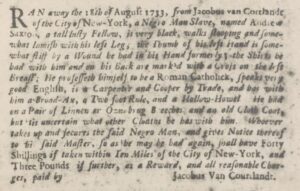
Runaway notice for Andrew Saxon, New York Gazette, October 1, 1733, NYPL

Jacobus Van Cortlandt, Mayor 1710-1711 and 1719-1720: Van Cortlandt (1658–1739) was a merchant who sold enslaved persons on consignment. He ran the family shipping business from the Caribbean and when he returned to New York City he continued to work in trade, brewing, farming, and milling. He sold flour, bread, bacon, and butter to Curacao and Jamaica, which is in his account book from 1699-1702. He sold the enslaved who arrived from the West Indies on consignment in New York City and the surrounding countryside.[1]

Van Cortlandt had enslaved people who did domestic chores, grew wheat, maintained roads, built barns, and operated two mills on his plantation, which is today’s Van Cortlandt Park in the Bronx.[2] He also sold enslaved people to nearby farmers.[3] Through his daughter Mary, he was the grandfather of Dr. James Jay (1732–1815) and John Jay (1745–1829).

Between 1698 and 1701, he sold enslaved people on consignment who were carried on ships from Antigua, Jamaica, Barbados, St. Christopher, Curaçao, Campeche, and Madeira.[4] Many of his letters in 1698 disclose the effect on the prices of enslaved persons after the arrival of ships from Madagascar owned by Frederick Philipse.

  • On April 15, 1698, Van Cortlandt wrote to Miles Mayhew that he received “one negro woman” on consignment from him but there was a “dull markett by reasons of three vessels coming in river with slaves – two from Madagascar and one from Gieny [Africa]…”[5] He wrote to another merchant the same day about “one negro” he received and the same complaint about the dull market.
  • On May 16, 1698, he wrote Mayhew about an enslaved woman he was unable to sell: “I have been very often in despair of Ever selling the woman for our Country-people do no Care to buy old slaves; therefore would advise you or any of your fiends to Send no Slaves to this place that exceed 25 Years of age.” In a letter to Barnabas Jenkins, he warned that a male slave with “distemper about his throat” would be unlikely be purchased.[6]
  • On May 20, 1698, he wrote to John Roe that he received money and “the negro man” sent on the sloop Dolphin, and the slave would be sold “for £40 to be paid in a month.”[7] He records other goods: logwood, rum, molasses, sugar, indigo, cotton, and pimento.
  • On June 4, 1698, he wrote to Mayhew and another merchant that large number of enslaved people from the three ships still “makes the slaves to sell very slow.”[8] He also notes molasses, rum, indigo, and cotton in the shipment.
  • On June 23, 1698, he wrote to Mayhew that he had sold two enslaved people belonging to Samuel Phillips, Jacob for £41 and the other for £38.[9]
  • On June 30, he wrote to Barnabas Jenkins he sold two enslaved persons that belonged to Madame Waterhouse.[10] He wrote to Jenkins again on July 16 that he received a slave that belonged to Charles Fuller but feared he would not sell due to “the distemper about his throat.”[11]
  • On August 18, 1698, he complained to a West Indies agent that “The Negro Mingo as yet not sold shall be forced at last to sell him at a low price because of his age besides the great quantity of slaves that are come to this place this year.”[12]

Frederick Philipse, a slave trader and likely the richest man in New York City, gave his grandson Frederick Philipse the bulk of his estate when he died in 1702, including his enslaved persons. He left Jacobus Van Cortlandt and his wife Eva de Vries (his adopted daughter) the house in New York City they lived in.[13]

  • In the c.1703 census, Van Cortlandt had five enslaved persons in his household in New York City.[14]
  • Van Cortlandt probably did not have live on his plantation. He had enslaved people (both Black and Indigenous persons) laboring there growing wheat, making improvements to the land, building barns, two mills, and building a dam that turned Tibbett’s Brook into a lake.[15]
  • A runaway notice from October 1, 1733, by Jacobus Van Cortlandt in the New York Gazette:

Ran away the 18th of August 1733, from Jacobus van Cortlandt of the City of New York, a Negro Man Slave, named Andrew Saxton, a tall lusty Fellow, is very black, walks slooping and somewhat lamish with his left Leg; the Thumb of   his left hand is somewhat still by a Wound he had in his Hand formerly; the shirts he had with him and on his Back are mark’d  with a Cross on the left Breast; He professeth himself to be a Roman Catholick, speaks very good English, is a Carpenter and  Cooper by Trade, and has with him a Broad-Ax, a Two-foot   Rule, and a Hollow-Howel.  He had on a Pair of Linnen or Oznabrug Breeches, and an old Cloth coat, but ‘tis uncertain what other Cloughs he has with him.  Whoever takes up and secures the Said Negro Man, and gives Notice thereof to his Said Master, So as he may be had again, shall have Forty Shillings if taken within Ten Miles of the City of New York, and Three Pounds if further, as a Reward, and all reasonable Charges, paid by Jacobus Van Cortlandt.[16]

Probate records show that in his will, Jacobus named these enslaved people as his property:

  • Pompey, identified as “my Indian man slave;” Piero “my negro man slave;” John “my negro man slave;” Frank “my negro man slave;” Hester a “negro woman;” and Hannah a “negro woman.”
  • Also unnamed, uncounted children, identified as the existing children of Hannah “Together with all their children that already are or hereafter shall be born of the body of the said negro woman Hester (except such of the said children as I may think fit in my lifetime to dispose of by deed of gift or otherwise).”[17]

His children included:

  • Frederick Van Cortlandt (1699–1749), who married Francina Jay, daughter of Auguste Jay and Anne Marika Bayard. Frederick built the Van Cortlandt House in 1748.
  • Mary Van Cortlandt, who in 1728 married Peter Jay (b. 1704), the brother of Francina Jay.
  • Margaret Van Cortlandt, who married Abraham De Peyster Jr., son of Mayor De Peyster.

In May 2018, the New York Times published a story on questions over current ownership of a graveyard of enslaved people on the Van Cortlandt property. In the article, the historian of the Van Cortlandt House Museum stated that Frederick Van Cortlandt and Augustus (his son) owned twenty-six enslaved people. In a circa 1790 census, Frederick is listed as owning nine enslaved people.[18] Frederick also owned a slave ship, the brigantine Dolphin.[19]

Van Cortlandt House Museum is part of a 1,000-acre urban park that encompasses what was once the Van Cortlandt family’s plantation. From its website:

When Frederick van Cortlandt had this house built in 1748-1749, it was part of Yonkers in Westchester County. Frederick van Cortlandt’s father, Jacobus, a wealthy merchant, first purchased land in this vicinity in 1693. Over the years, the Van Cortlandts continued purchasing lots from local farmers until they amassed a large estate stretching well beyond the boundaries of modern Van Cortlandt Park. In 1701, Jacobus van Cortlandt paid local Munsee Lenape people to secure legal ownership of the land, which the Van Cortlandts referred to as their “Yonkers plantation.” In the colonial period, Van Cortlandt Park’s modern day athletic fields were filled with acres of wheat, buckwheat, rye, and corn in addition to farm animals.

Three generations of the Van Cortlandt family held enslaved Africans on the property from 1698 until 1823. Some, such as Dinah, worked as house servants. Others, like Piero the miller and Levellie the boatman, performed skilled labor that increased the profitability of the plantation. Enslaved Africans held by the Van Cortlandts left a legacy in today’s Van Cortlandt Park that is still visible.

__________________________________________________________________________________________________________________________

[1] Jacobus Van Cortlandt Shipments Book, NYHS v20 n04, Quarterly Bulletin, October 1936, link, “Archaeological Excavations at Van Cortlandt Park,” The Bronx, 1990-1992, link; Black and White Manhattan, Chapter 2; Liberty’s Chain, p.20 footnote 25

[2] Stephanus: Northeast Slavery Records Index; New York Probate Records, 1665-1699 vol 1-2, April 14, 1700, FamilySearch.com; Jacobus: In the c.1703 census, Jacobus had five slaves in his household in New York City. U.S. Census, Before 1790, NYC Dock Ward.  While Jacobus may not have lived on his plantation, he did have enslaved people (both Africans and Native Americans) working there. Van Cortlandt House and Museum, link. The Van Cortlandt House and Museum website and probate records reveal the slaves of Jacobus, New York, U.S., Wills and Probate Records, 1659-1999, Probate Date 13 Sep 1740, Ancestry.com

[3] Liberty’s Chain: Slavery, Abolition, and the Jay Family of New York, p.20 footnote 25. New York City, 1664-1710: Conquest and Change. “New York Slave Trade, 1698-1741: The Geographical Origins of a Displaced People,” Jeanne Chase, 2003, link

[4]  “New York Slave Trade, 1698-1741: The Geographical Origins of a Displaced People,” Jeanne Chase, 2003, link

[5] Archival Collection Papers, 1698-1702. Van Cortlandt, Jacobus, 1658-1740? 1698 – 1702, The New York Historical, digital p.4

[6] Black and White Manhattan, Chapter 2

[7] Archival Collection Papers, 1698-1702. Van Cortlandt, Jacobus, 1658-1740? 1698 – 1702, The New York Historical, digital p.11

[8] Archival Collection Papers, 1698-1702. Van Cortlandt, Jacobus, 1658-1740? 1698 – 1702, The New York Historical, digital p.12-13

[9] Archival Collection Papers, 1698-1702. Van Cortlandt, Jacobus, 1658-1740? 1698 – 1702, The New York Historical, digital p.18

[10] Archival Collection Papers, 1698-1702. Van Cortlandt, Jacobus, 1658-1740? 1698 – 1702, The New York Historical, digital p.19

[11] Ibid., digital p.24

[12] The New York African Burial Ground: Unearthing the African Presence in colonial New York, Vol. III, GSA, report

[13] Marriage Indenture of Eva Philipse and Jacobus Van Cortlandt, November 1690, Historic Hudson Valley, link; Abstracts of wills on file in the Surrogate’s Office, City of New York, 1665-1801. V. 1, Page viewer p.378, Will dated October 26, 1700, FamilySearch, link

[14] U.S. Census, Before 1790, NYC Dock Ward

[15] Van Cortlandt House and Museum, link

[16] Pretends to be Free: Runaway Slave Advertisements from Colonial and Revolutionary New York and New Jersey. New York: Taylor and Francis, 1994, p.9

[17] New York, U.S., Wills and Probate Records, 1659-1999, Probate Date 13 Sep 1740, Ancestry.com

[18] Northeast Slavery Records Index, citing Van Cortlandt House Museum website

[19] Intra-American Slave Voyage Database #107779; Donnan p.495; and #107793, Donnan p.496

Copyright 2025 Paul Hortenstine

Thomas Delavall: 2nd, 5th, & 12th

Thomas Delavall (Delaval or De Lavall), Mayor 1666-1667, 1670-1671, and 1678-1679: Delavall (1620 – 1682) was a merchant and government official. He also spent part of his time in Albany on the council of the provincial governor. In 1670, Governor Francis Lovelace granted him permission to build a house in Albany, and he was appointed as an Albany magistrate.

In 1673, his property was confiscated by the Dutch when they re-took the province. However, in September 1676, he was in Albany for an extraordinary session of the court. In Albany court records, Capt. Delavall owned a mortgage on an enslaved woman, Anna, in December 1676. The records state:

Monsr. Willem Beekman, administrator of the estate of the late widow Corlaer, deceased, standing inside, requests that the honorable court be pleased to appoint two impartial men to appraise the negress Anna (without her child), as by a mortgage dated December 1, 1676, she is bound to Capt. Delavall. Whereupon the honorable court request and authorize Mr. Wm. Teller and Mr. Marte Criger to appraise the said negress and to report to their honors.[1]

Court records also state that Delavall had a servant named Franck. It is unclear if this was an enslaved man.[2]

[1] Minutes of the court of Albany, Rensselaerswyck, and Schenectady, 1668- 1685…, Vol. II, p.232 and p.164 for Sept.; her will, Antonia Jufrow Slackboom is in Ancestry.com, New York, U.S., Wills and Probate Records, 1659-1999, Will and Probate 15 Jan 1676

[2] Minutes of the court of Albany, Rensselaerswyck, and Schenectady, 1668- 1673…, Vol. I, p.276

Copyright 2025 Paul Hortenstine

Matthias Nicolls: 6th & 8th

Matthias Nicolls (Nicoll), Mayor 1671-1672 and 1674-1675: Nicoll (1626? – 1687) was the founder of the Nicoll family and many of his descendants were prominent in New York politics. He lived on an estate on Long Island, called Plandome Manor. He was secretary to Richard Nicolls, the first governor of New York. They were not related. As secretary, Nicolls drafted the Duke’s Laws, which combined English and Dutch law and recognized slavery, which was a more informal practice in New Netherland. Records of servitude were to be entered in the Court of Sessions for each jurisdiction.[1]

Nicolls came to New York City sometime in 1664 and was one of the most powerful officials in the province. While mayor, Nicolls held three important positions: a member of the governor’s council, provincial secretary, and mayor of New York City. Nicolls first term as mayor was from 1671 to 1672 and his second appointment was from 1674 to 1675. Nicolls served as provincial secretary to the colonial governor from the founding of the English colony in 1664 until 1680. Nicolls also sat on the colonial governor’s council—the supreme governing body of the colony—from 1667 to 1680. He also worked in private practice as an attorney.

One of Nicolls most notable achievements was compiling the Duke’s Laws, the legal code of the Province of New York. The laws were unevenly enforced, but they did codify slavery for the first time. In his recent book Taking Manhattan, historian Russell Shorto states that in 1665 Nicolls “took on the task of creating a legal code for the colony that mixed features of the English and Dutch systems.” Shorto writes that the code turned slavery from “what had been an informal practice in New Netherland into a legalized institution.”

In September 1676, Nicolls sold an enslaved man in a transaction with Nicholas Blake. The sale is listed in a letter Blake sent to Nicolls about their accounts. [2]

[1] Taking Manhattan, p.295

[2] Andros Papers, 1677-78, p.62-63; Nicoll was mayor in 1674 and 1675, Select cases of the Mayor’s court of New York City, 1674-1784, p.45-46, FamilySearch; NY Genealogical Society, July 1989: Volume 120, issue 3, Peter Cristoph, link

Copyright 2025 Paul Hortenstine

John Lawrence: 7th & 20th

John Lawrence (Jan Lawrens), Mayor 1672-1673 and 1691: Lawrence (1618–1699) was a merchant in the dry goods trade. He had enslaved people at his farm in Hampstead, Long Island. His daughter, Susannah, married another mayor, Gabriel Minvielle.[1]

His participation in slavery:

  • The book Root & Branch states that during the Dutch period, “some slaves labored on large plantations outside of the city, such as Captain John Lawrence’s plantation at Hempstead…”[2]
  • On May 29, 1664, “John Laurence” is listed as purchasing “1 negro” for 345 florins at an auction. This enslaved person was on the ship Musch, owned by Matthias Beck of Curaçao.[3]

Lawrence also “owned a small trading-vessel called the Adventure, with which he carried on a profitable business with the towns along the Hudson River as far as Albany, and with those on both sides of Long Island Sound.”[4]

[1] Merchants & Empire, p.420-21, n.16

[2] Root & Branch, p.31, there is also a cousin John Lawrence who lived in Flushing

[3] Documents Illustrative of the Slave Trade, p.428; “To experiment with a parcel of negros,” p.64

[4] The Memorial History of the City of NY, Vol. II, 1892, p.51

Copyright 2025 Paul Hortenstine

William Dervall: 9th

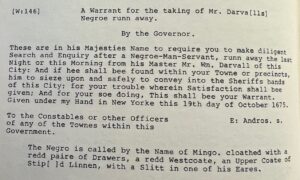
October 19, 1675, runaway notice, New York Historical Manuscripts Books of General Entries, Vol. II

Mayor William Dervall (Darvall or Der Val), Mayor 1675-1676: Dervall (c.1642-1712) was named mayor of New York City by Governor Edmond Andros. He was a merchant and his father, Cornelius, facilitated trade with Dover and Amsterdam. William traded with the West Indies and built a trading network with Boston merchants. He married Rebecca Delavall, the daughter of Mayor Thomas Delavall.[1] Dervall had an indentured servant, John Williams.[2]

There is a runaway warrant for Dervall’s enslaved man, Mingo, on October 19, 1675. It was issued by the governor, Edmund Andros. It states:

These are in his Majesties Name to require you to make a diligent Search and Enquiry after a Negroe-Man-Servant, runn away the last Night or this Morning from his Master Mr. Wm. Darvall of this City: And if hee shall bee found within your Towne or precincts, himn to sieze upon and safely to convey into the Sheriffs hands of this City; for your trouble wherein Satisfaction shall bee given; And for you soe doing, This shall bee your Warrant…The Negro is called by the Name of Mingo, cloathed with a redd paire of Drawers, a redd Westcoate, and Upper Coate of Stip[]d Linnen, with a Slitt in one of his Eares. [3]

[1] “Commerce and Community: Manhattan Merchants in the Seventeenth Century,” Dennis J. Maika, 1995

[2] Court files: Maine. Court Records 1679–1680 | Massachusetts. Court Records 1679–1680 | Suffolk. Court Records 1679–1680, view page 422, FamilySearch, link

[3] New York Historical Manuscripts Books of General Entries, Vol. II, p.80

Copyright 2025 Paul Hortenstine